How GEO Work Gets Priced: Six Variables
Price differences in this category come from differences in workload structure, and workload follows six variables: question-pool size and language count, content-format mix, off-site channel count…

XstraStar Editorial Team
GEO Research & Strategy

In this article
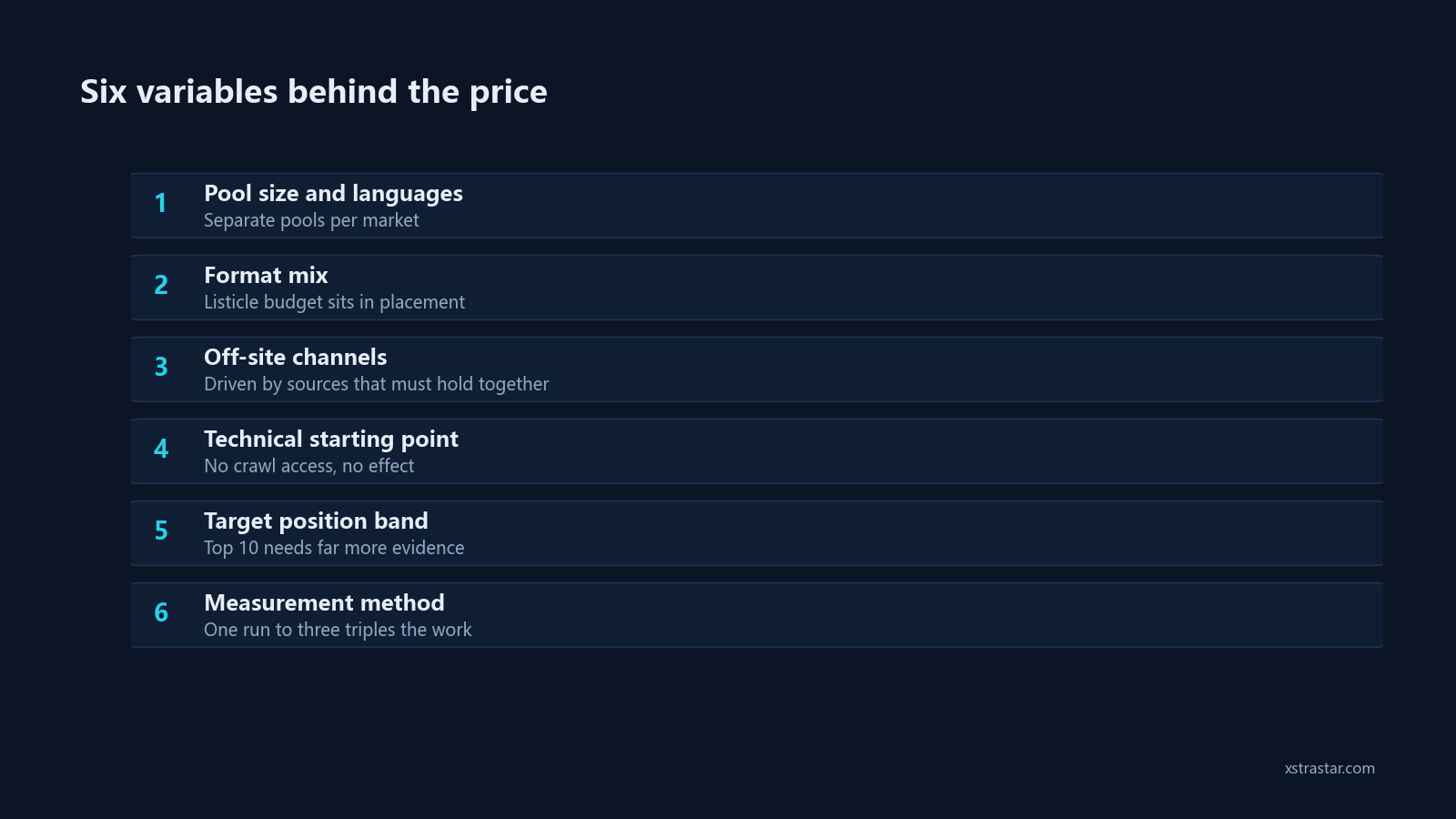
Price differences in this category come from differences in workload structure, and workload follows six variables: question-pool size and language count, content-format mix, off-site channel count, the site's technical starting point, the target position band, and measurement method. Read those six and the gap between three quotes becomes explainable.
This piece covers pricing logic only, with no figures.
1. Question-pool size and language count
The pool is both the denominator for measurement and the source of the content list, so it sets how many pages get written and how many questions get monitored.
Languages do not multiply cleanly. A second language costs less than double and far more than nothing: the same intents are phrased differently and the source ecosystem differs, so structure travels and material does not. Chinese and English markets need separate pools; a single merged pool usually means one side is uncovered.
2. Content-format mix
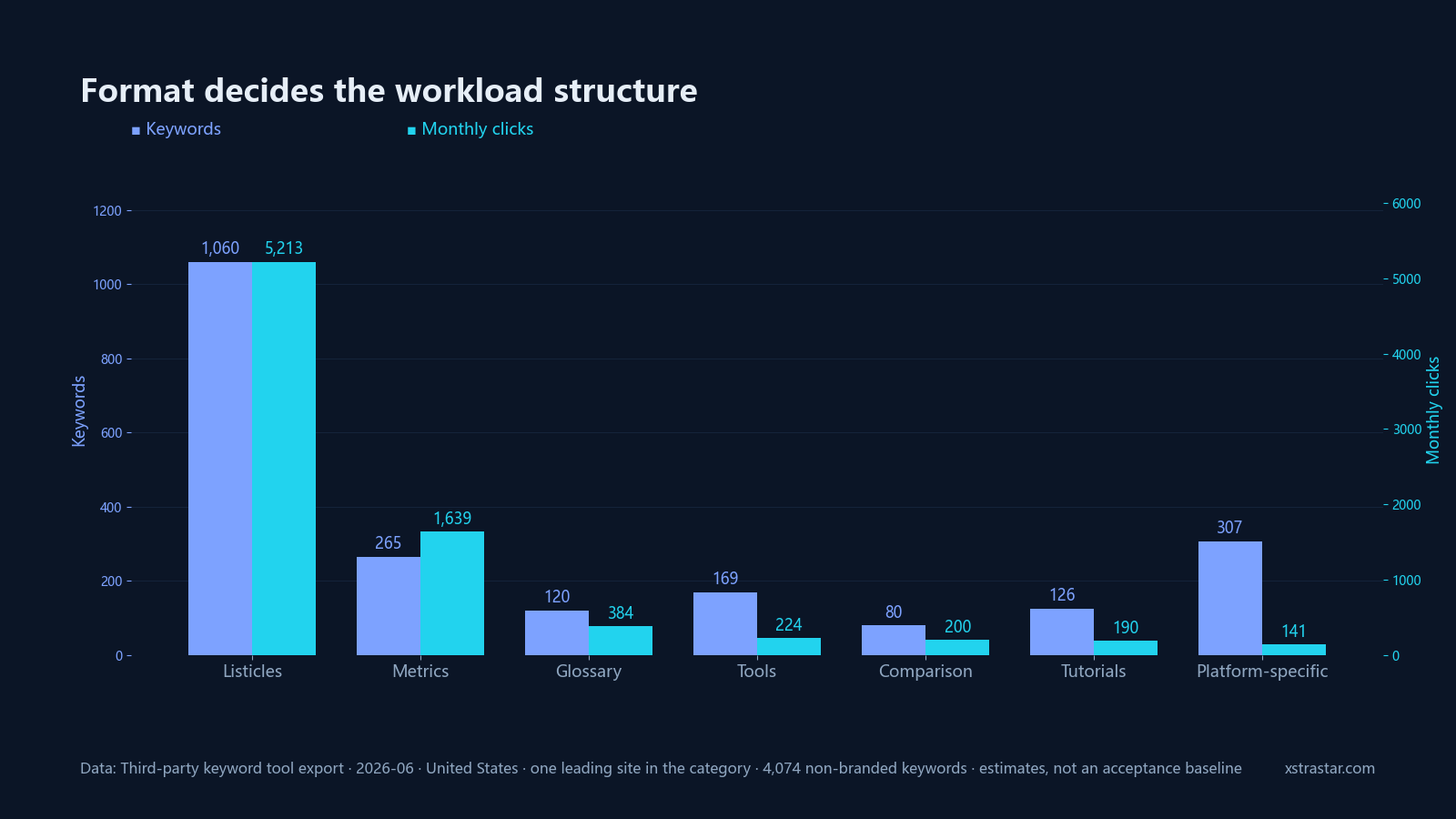
Unit cost varies sharply by format, and so does traffic contribution. Third-party per-keyword export, 2026-06, United States, one leading site in this category, 4,074 non-branded keywords:
| Format | Keywords | Monthly clicks | Share | Cost characteristic |
|---|---|---|---|---|
| Listicles / selection | 1,060 | 5,213 | 44% | Needs third-party placement; budget sits in channels |
| Metrics / measurement | 265 | 1,639 | 14% | Needs real data and stated method; highest writing cost |
| Glossary / definitions | 120 | 384 | 3% | Batchable; lowest unit cost |
| Tools / free utilities | 169 | 224 | 2% | Needs development; marginal cost near zero afterwards |
| Comparison pages | 80 | 200 | 2% | Needs a position and a compliance pass |
⚠️ The listicle row drives the widest price spread. Its citation value comes from third-party standing, so that budget belongs to placement and not to writing. A quote that lists listicle pages as owned-site deliverables has not separated the two.
3. Off-site channels and multi-source corroboration
One article on one channel moves the answer side very little. The same conclusion corroborated across several channels enters candidate sets more reliably. The quantity here follows the number of sources that must hold simultaneously, which is a different quantity from article count.
4. The site's technical starting point
Crawl-layer state decides how much work precedes everything else: whether retrieval crawlers are allowed, whether content arrives inside server-rendered HTML, whether structured data exists, whether a gateway blocks access. Until that layer works, no content work takes effect, so it behaves as fixed pre-launch investment independent of page count.
5. Target position band
Reaching the top 10 requires far more evidence than merely having a page. The same dataset shows 13.1 monthly clicks per keyword at positions 1–3, 3.4 at 4–10 and 0.1 at 11–20. The chosen band sets how much data, external citation and rewriting each page needs.
6. Measurement method
Monitoring volume equals questions × runs per question × platforms × collection frequency, plus human verification. Moving from 1 run to 3 triples it. Figures fit for publication and figures fit for internal direction sit at different cost levels.
Using the six
| Situation | The question to ask |
|---|---|
| Comparing three quotes | What quantity is attached to each of the six, and which ones are absent |
| A quote looks low | Usually a small pool, a single language, or one off-site channel |
| A quote looks high | Check whether technical remediation and development-type pages are included; both are one-off |
| Phasing the work | Start with variable 4 and variable 1; until those close, every other quantity is a guess |
⚠️ Keep commitments separate from price. A validation phase can commit to measurable mention gains and a working measurement chain; organic growth belongs to the full engagement. When a quote promises a ranking outcome or an indexing outcome, the problem sits elsewhere than in the price.
Key takeaway: GEO pricing follows workload structure across six variables: question-pool size and language count (Chinese and English need separate pools), content-format mix (a 2026-06 third-party study shows listicle and selection formats taking 44% of category clicks, with that budget sitting in placement instead of writing), off-site channel count and corroboration requirements, the site's technical starting point (fixed pre-launch investment, independent of page count), the target position band (13.1 monthly clicks per keyword at positions 1–3 against 0.1 at 11–20), and measurement method (questions × runs × platforms × frequency; three runs instead of one triples the work). When phasing, close the technical starting point and the question pool first, because every other quantity depends on them.
Related: Commitment tiers | What not to promise | Resourcing and cadence | Page type matrix | Crawlability first
Sources: Format, keyword counts and click distribution from a third-party keyword tool export (2026-06, United States, one leading site in the category, 4,074 non-branded keywords); estimates, not an acceptance baseline. The six-variable breakdown from XstraStar delivery practice.
Last updated: 2026-08-27
Turn insight into growth
Find your next AI search growth opportunity
From brand visibility and citation sources to content strategy, the XstraStar team will help you map a clear, measurable GEO optimization path.
Talk to a GEO advisorAbout the author
XstraStar Editorial Team
GEO Research & Strategy
The XstraStar editorial team studies AI search, generative engine optimization, and brand visibility, turning platform mechanics, field experience, and market shifts into practical growth guidance.
Related insights


