On Half The Budget, Cut Page Count And Keep Format Coverage
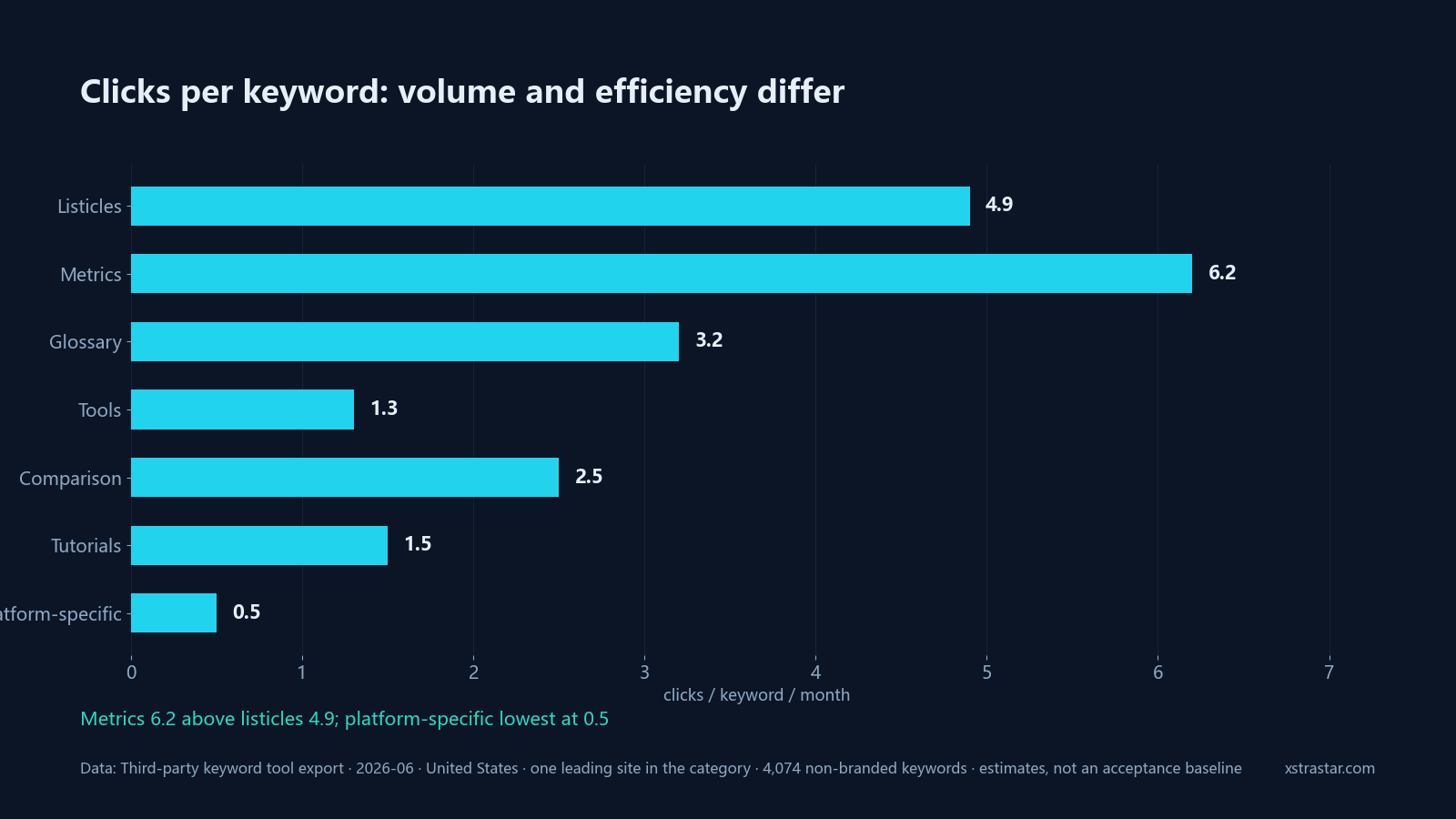
Cut volume, protect format coverage. In one per-keyword study, the two formats holding 58% of category clicks occupied 1,325 keyword slots, while the glossary format holding 3% occupied 120.

XstraStar Editorial Team
GEO Research & Strategy

In this article
Cut volume, protect format coverage. In one per-keyword study, the two formats holding 58% of category clicks occupied 1,325 keyword slots, while the glossary format holding 3% occupied 120. Spreading a thin budget evenly across formats spends the most expensive capacity on the smallest contributor.
Return by format
Third-party keyword tool export, 2026-06, United States, one leading site in this category, 4,074 non-branded keywords, 11,864 organic clicks per month.
| Format | Keywords | Monthly clicks | Share | Clicks per keyword |
|---|---|---|---|---|
| Listicles / selection | 1,060 | 5,213 | 44% | 4.9 |
| Metrics / measurement | 265 | 1,639 | 14% | 6.2 |
| Glossary / definitions | 120 | 384 | 3% | 3.2 |
| Tools / free utilities | 169 | 224 | 2% | 1.3 |
| Comparison pages | 80 | 200 | 2% | 2.5 |
| Tutorials | 126 | 190 | 2% | 1.5 |
| Platform-specific | 307 | 141 | 1% | 0.5 |
Highest clicks per keyword belongs to the metrics format (6.2), not to the format with the most keyword slots (4.9). Listicle volume comes from slot count; metrics efficiency comes from tighter intent per page. On a thin budget, efficiency deserves more attention than totals.
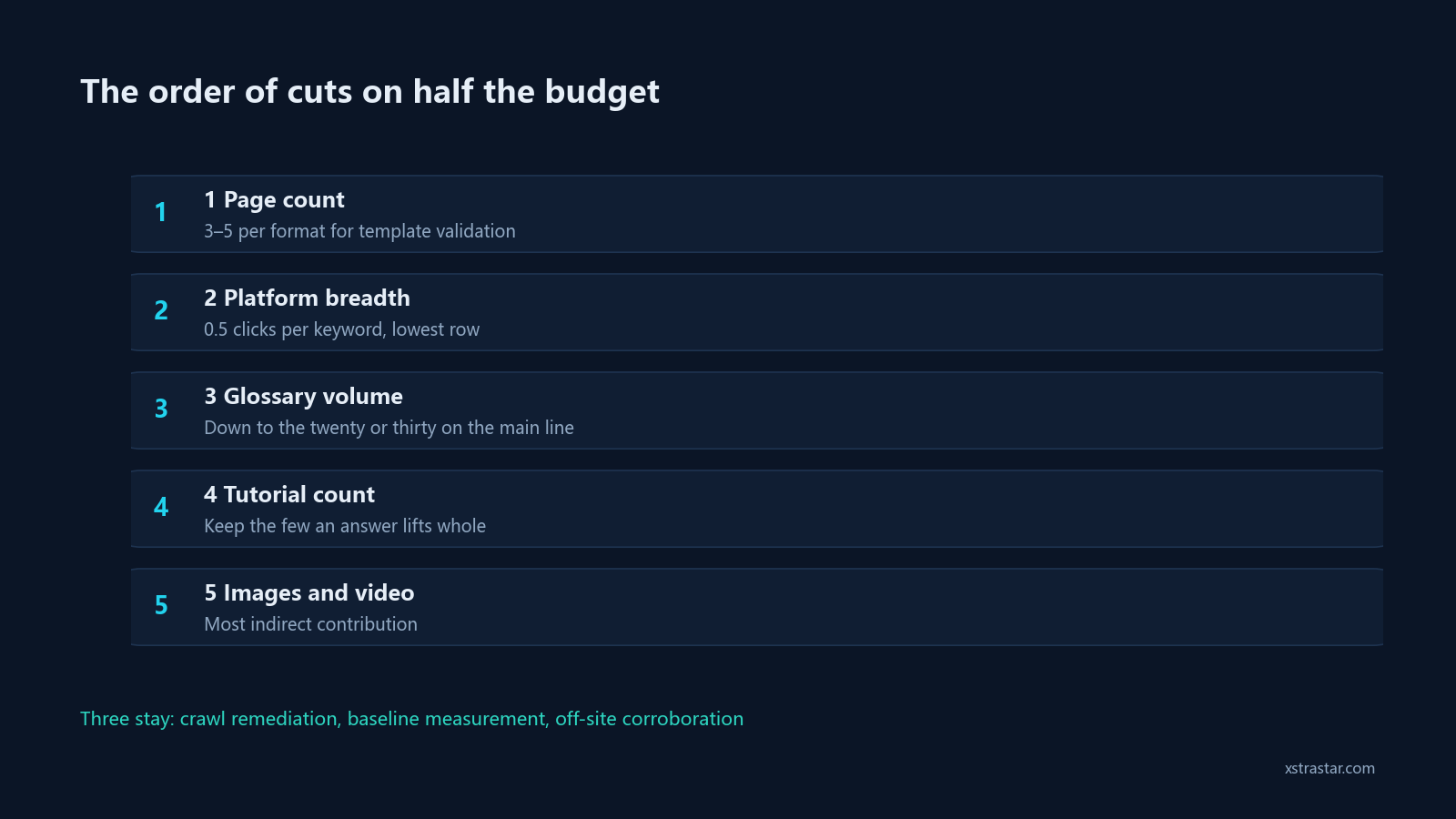
The order of cuts
| Order | Cut | Why it survives cutting |
|---|---|---|
| 1 | Page count: keep 3–5 pages per format for template validation, defer the rest | Copying an unvalidated template multiplies rework |
| 2 | Platform-specific breadth: cover the one or two platforms that measurement shows citing most, defer the others | 0.5 clicks per keyword, the lowest row in the table |
| 3 | Glossary volume: compress from hundreds to the twenty or thirty tied to the main line | Lowest unit cost, and only 3.2 clicks per keyword; easy to add back later |
| 4 | Tutorial count: keep the few an answer can lift whole | 2% of clicks; value sits in citation and conversion, not traffic scale |
| 5 | Images and video | Outside video transcripts, the most indirect contribution to the answer side |
Three items that stay
Crawl-layer remediation. While retrieval crawlers cannot reach complete content, no content work takes effect. This is fixed pre-launch investment, independent of page count, and cutting it converts the whole budget into sunk cost.
Baseline measurement. Without a method-labelled baseline, quarter-end offers no way to attribute change and the next budget has no basis. A baseline costs a fraction of a quarter of production.
Off-site corroboration across sources. One conclusion on one channel barely moves the answer side. Cut this as a whole block (no off-site work this cycle) and never cut it down to a single channel, which spends money on a quantity too small to enter candidate sets.
Acceptance changes with the budget
| Original metric | Replacement on half the budget |
|---|---|
| Pages inside the top 10 | Whether each format's template is validated (at least one page per format inside the top 10) |
| Organic traffic gain | Band migration (how many pages moved from 11–20 into 4–10) |
| Off-site channel coverage | Declared out of scope this cycle |
⚠️ A common mistake: cutting measurement first. Once measurement goes, whether the remaining money was spent correctly becomes unknowable, and the next cycle repeats the error. Measurement volume can drop (3 runs to 1, weekly to monthly), and it should not reach zero, and the reduced figures then serve internal direction only.
Key takeaway: On a reduced budget, cut page count and protect format coverage. A 2026-06 third-party study (United States, one leading site in the category, 4,074 non-branded keywords, 11,864 monthly clicks) shows listicle formats at 44% of clicks and metrics at 14%, with the highest clicks per keyword in metrics (6.2) over listicles (4.9) and platform-specific lowest (0.5). Cut in this order: page count (3–5 per format for template validation), platform breadth, glossary volume, tutorial count, images and video. Three items stay: crawl-layer remediation, method-labelled baseline measurement, and off-site corroboration (cut as a whole block, never down to one channel). Acceptance then shifts to template validation and band migration, and measurement may drop in frequency without reaching zero.
Related: Staged publishing | When GEO is not worth it | Page type matrix | Resourcing and cadence
Sources: Format, keyword counts and click distribution from a third-party keyword tool export (2026-06, United States, one leading site in the category, 4,074 non-branded keywords); estimates, not an acceptance baseline. Clicks per keyword derived by dividing the two columns. Cut order from XstraStar delivery practice.
Last updated: 2026-08-27
Turn insight into growth
Find your next AI search growth opportunity
From brand visibility and citation sources to content strategy, the XstraStar team will help you map a clear, measurable GEO optimization path.
Talk to a GEO advisorAbout the author
XstraStar Editorial Team
GEO Research & Strategy
The XstraStar editorial team studies AI search, generative engine optimization, and brand visibility, turning platform mechanics, field experience, and market shifts into practical growth guidance.
Related insights


