What An SEO Team Already Covers, And What It Does Not
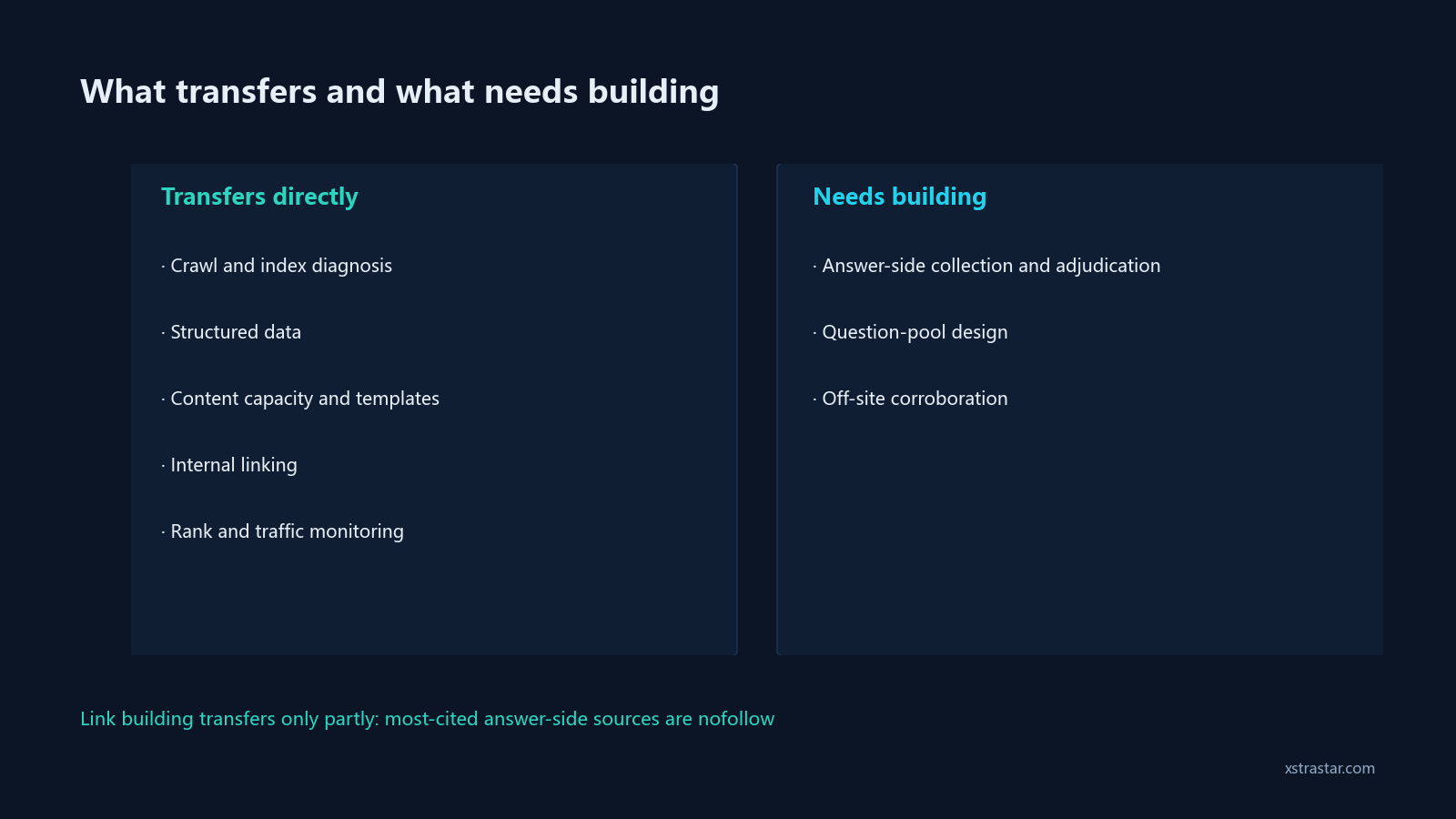
A mature SEO team already holds roughly half of what this work needs: the technical layer, content capacity and rank monitoring all transfer directly.

XstraStar Editorial Team
GEO Research & Strategy

A mature SEO team already holds roughly half of what this work needs: the technical layer, content capacity and rank monitoring all transfer directly. The missing half consists of three concrete things: answer-side collection and adjudication, question-pool design, and off-site corroboration across sources.
This is a difference in subject matter, not in skill. SEO acts on rankings in a result page. This work acts on the candidate set inside an answer.
What transfers directly
| Capability | How it applies here |
|---|---|
| Crawl and index diagnosis | Transfers as is, with an extra set of retrieval crawlers to allow, and with retrieval crawlers separated from training crawlers |
| Structured data | Transfers, and matters more, because the answer side leans harder on parseable fields |
| Content capacity and page templates | Transfers, with the page-type list retuned to answer-side format preferences |
| Internal linking and site structure | Transfers as is |
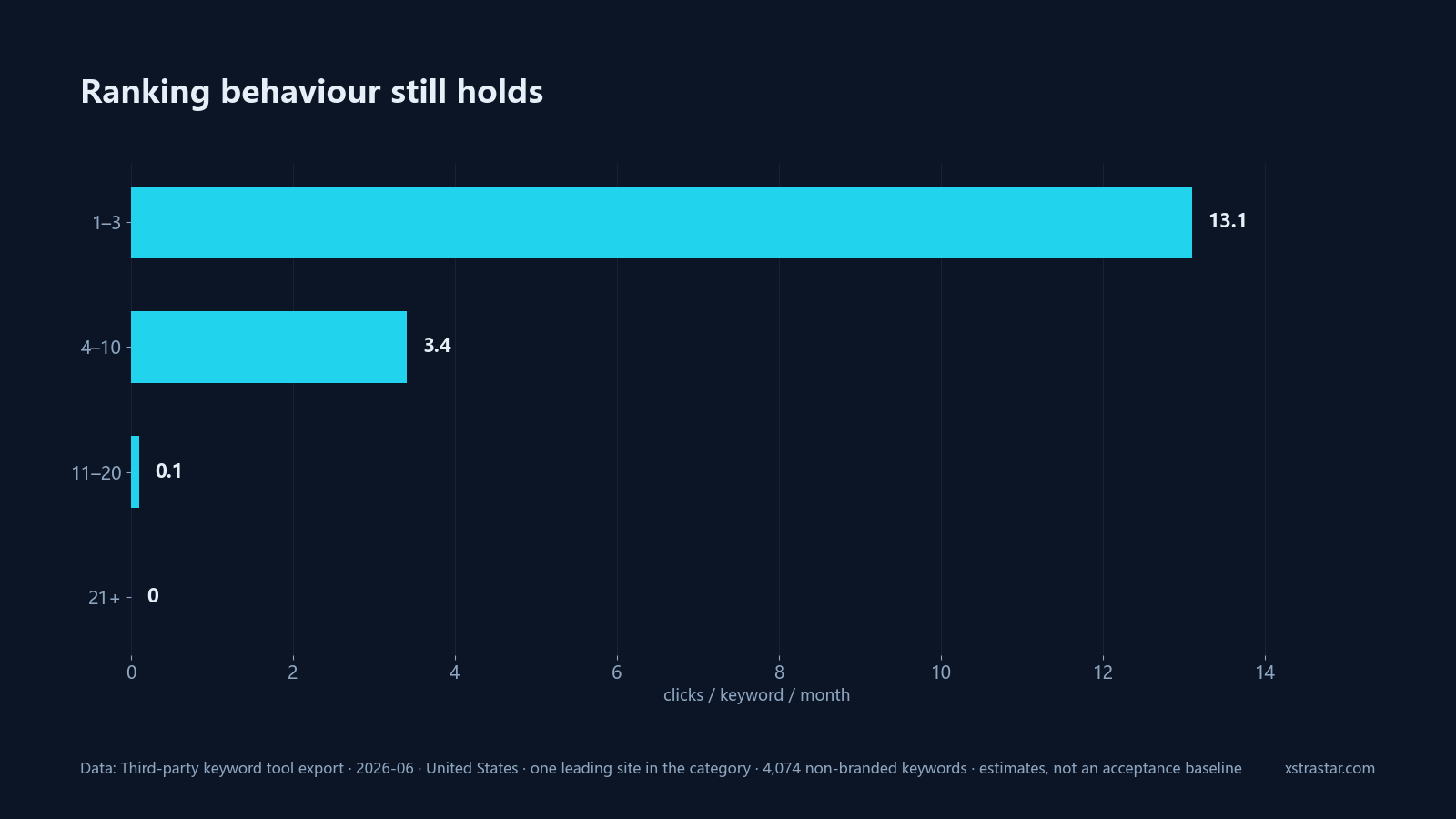
| Rank and traffic monitoring | Transfers. A third-party per-keyword export (2026-06, United States, one leading site in this category, 4,074 non-branded keywords) still shows 13.1 monthly clicks per keyword at positions 1–3 and 0.1 at 11–20 |
| Link building | Transfers partially. ⚠️ Most of the source types cited most often on the answer side are nofollow, so link equity and citation need separate budgets and separate acceptance |
The missing half
Answer-side collection and adjudication. Rankings come out of a tool; answers do not. Questions have to be asked against a fixed pool on each platform, with answers and sources stored, and brand presence adjudicated. Three traps live here: the same question re-run returns different answers (so sampling repeats), literal string matching both misses and over-collects (so literal and semantic checks run together), and some platforms return no source URL (so page-level attribution is unavailable on that side).
Question-pool design. SEO takes keywords as input; this work takes questions. One question maps to dozens of surface phrasings, and the pool defines both the mention-rate denominator and the content list. Three hard requirements: layer by buyer journey, keep brand names out of the question text, and freeze the pool once set, because changing questions makes two periods incomparable.
Off-site corroboration. The answer side shows strong inertia toward heavily cited sources, so a conclusion appearing in one place struggles to enter candidate sets. Quantity here follows the number of sources that must hold simultaneously, which puts execution closer to PR scheduling than to link buying.
A side-by-side view
| Work item | Already in place | Needs building |
|---|---|---|
| Whether pages can be crawled | ✅ | |
| Where pages rank in a result page | ✅ | |
| Whether pages get cited inside answers | ✅ | |
| Whether the brand appears in answer text | ✅ | |
| Where the question list comes from, and the denominator | ✅ | |
| How many third-party sources carry the same conclusion | Partial | ✅ |
| How a report explains where change came from | Partial | ✅ |
Ways to close the gap
- Build it. Add a collection chain (fixed pool × platforms × repeated sampling) and a written adjudication rule. Cost sits in ongoing operation and human verification, not in one-off development.
- Tool plus own adjudication. Self-service monitors handle running the pool, storing answers and drawing charts. Pool design and verification stay in house, and without those two the tool's percentages remain unusable.
- External answer side, internal site side. Clean division of labour, on one condition: both sides share one method, especially the mention-rate denominator and the number of runs per question.
⚠️ The arrangement that fails most often: site work internal, off-site and monitoring external, and each side issuing its own report. Two methods produce two conclusions that contradict each other at quarter-end. Split the work; keep one method.
Key takeaway: A mature SEO team already covers about half of this work — crawl and index diagnosis, structured data, content capacity and page templates, internal linking, and rank monitoring all transfer, while link building transfers only partially because the most-cited answer-side source types are largely nofollow, requiring separate budgets for link equity and citation. Three things need building: answer-side collection and adjudication (repeated sampling, literal plus semantic checks, no page-level attribution where platforms withhold URLs), question-pool design (questions instead of keywords, layered by buyer journey, no brand names in question text, frozen once set), and off-site corroboration across multiple sources. Whichever delivery split is chosen, both sides must share one measurement method.
Related: GEO vs SEO | Retrieval vs training crawlers | Prompt set design | Off-site is most of the weight | Resourcing and cadence
Sources: Position bands and click distribution from a third-party keyword tool export (2026-06, United States, one leading site in the category, 4,074 non-branded keywords); estimates. Capability mapping and the three gaps from XstraStar delivery practice.
Last updated: 2026-08-27
Turn insight into growth
Find your next AI search growth opportunity
From brand visibility and citation sources to content strategy, the XstraStar team will help you map a clear, measurable GEO optimization path.
Talk to a GEO advisorAbout the author
XstraStar Editorial Team
GEO Research & Strategy
The XstraStar editorial team studies AI search, generative engine optimization, and brand visibility, turning platform mechanics, field experience, and market shifts into practical growth guidance.
Related insights