Keyword Difficulty Is A Sorting Tool, Not A Cut-Off
A difficulty cut-off such as "only build for KD 20 or below" removes the most valuable part of this category.

XstraStar Editorial Team
GEO Research & Strategy

In this article
A difficulty cut-off such as "only build for KD 20 or below" removes the most valuable part of this category. In one per-keyword study, 554 keywords that reached the top 10 sat between KD 15 and KD 29.
Difficulty scores are useful for ordering work already judged worth doing, and for sizing how much evidence and time each direction needs.
What the distribution looks like
Third-party keyword tool export, 2026-06, United States, one leading site in this category, 4,074 non-branded keywords.
| Content format | Keywords | Avg. difficulty | Monthly clicks | Share |
|---|---|---|---|---|
| Listicles / vendor selection | 1,060 | 23 | 5,213 | 44% |
| Metrics / measurement | 265 | 25 | 1,639 | 14% |
| Comparison pages | 80 | 19 | 200 | 2% |
| Platform-specific | 307 | 32 | 141 | 1% |
| Glossary / definitions | 120 | 33 | 384 | 3% |
Two readings are immediately usable:
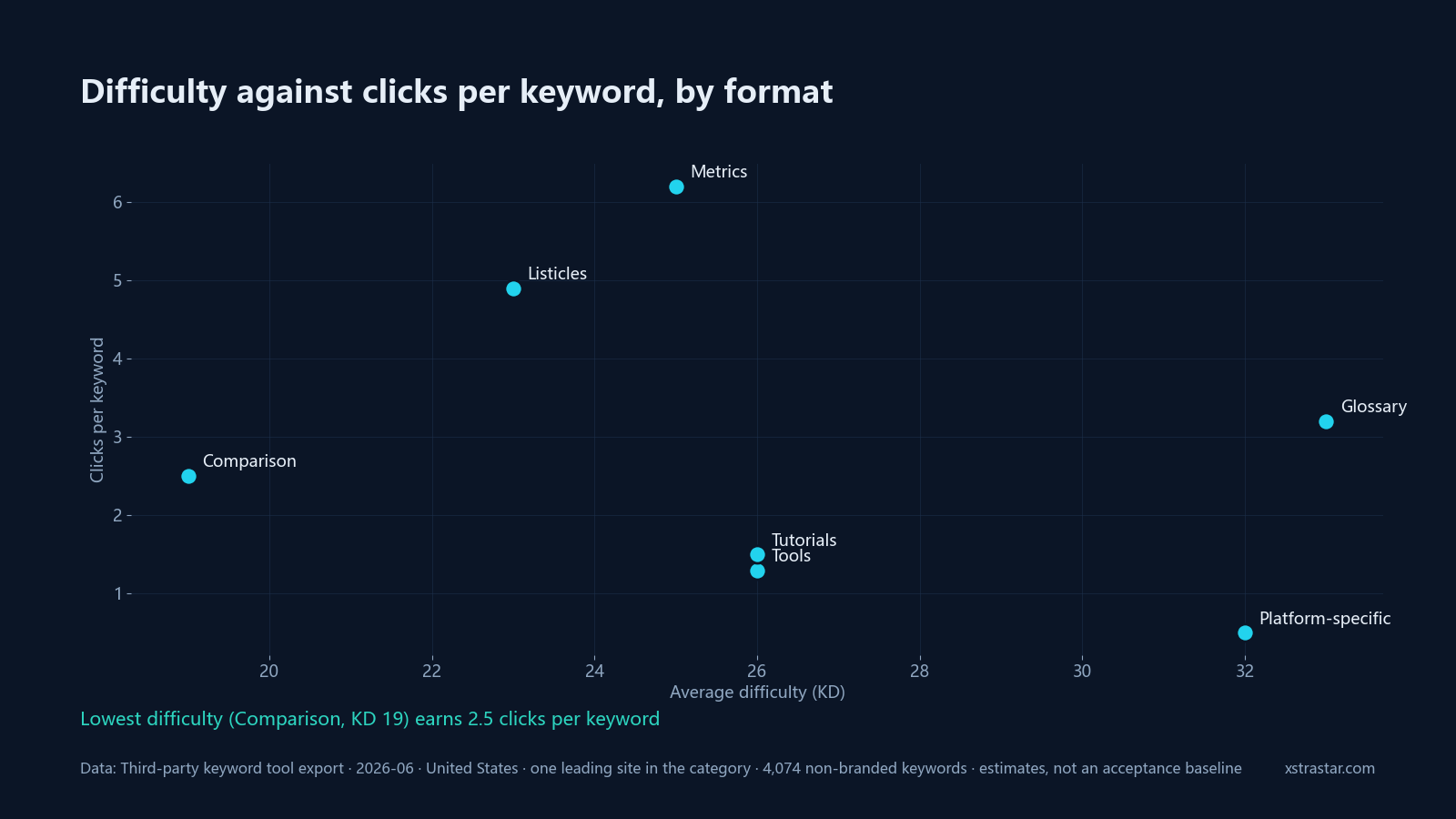
- The two formats earning the most clicks both sit at difficulty 23–25. A KD 20 cut-off deletes 58% of all clicks in one move.
- The lowest-difficulty format in the table earns 2% of clicks. Low difficulty and high priority are different things; comparison pages earn their place through purchase intent, not through volume.
Three limits of the score itself
| Limit | Consequence |
|---|---|
| It is a third-party estimate derived from links and domain authority | Two tools can differ by more than ten points on the same keyword, so cross-tool comparison means nothing |
| It measures difficulty of entering the top 10, and says nothing about clicks earned after arriving | A KD 8 keyword with 20 monthly searches stays small at position 1 |
| It does not measure difficulty of being cited by a generated answer | Citation and ranking run on separate mechanisms, and difficulty has no predictive power over citation |
⚠️ The third limit matters most here. Pages that will not reach the top 10 can still be quoted inside an AI summary, and a difficulty filter discards that upside silently.
A workable ordering method
Score each candidate direction on three axes, then sort:
- Volume, including the variant phrasings a single page can serve. When one page answers four phrasings of the same question, the volumes combine.
- Reachability: the difficulty score, plus one check the score cannot give — where existing pages already rank for that keyword. A keyword sitting at position 11–20 pays back rewriting far faster than a new page pays back creation.
- Intent value: awareness, comparison or decision stage. Decision-stage keywords come first even when small.
Use difficulty in three bands and set no hard gate. The 15–29 band is the main field. Below 15, confirm real volume exists. Above 30, run the direction as a separate project with a longer horizon and more external evidence, and keep it out of the quarter's acceptance metrics.
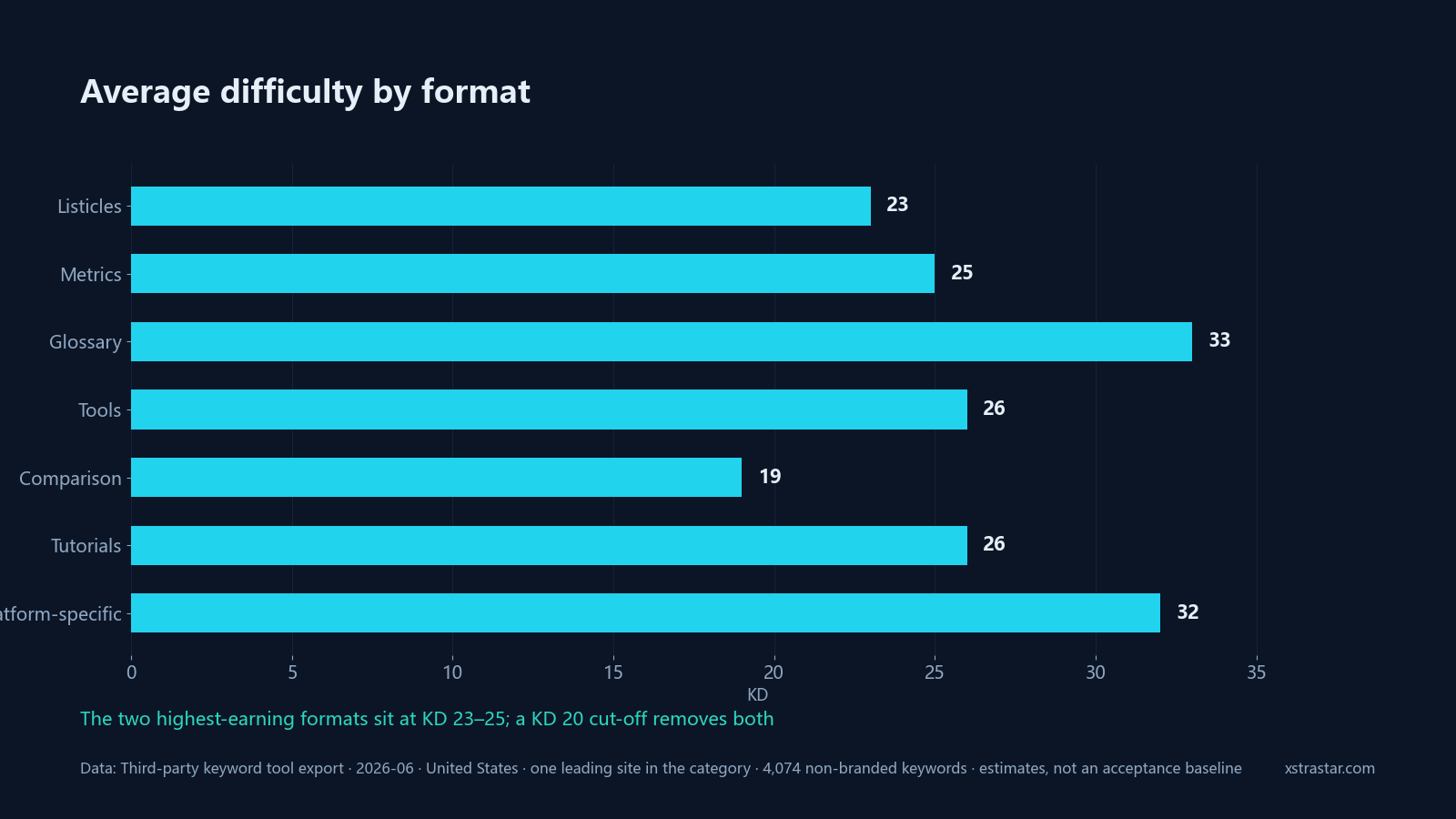
Key takeaway: Keyword difficulty belongs in prioritisation, not in filtering. A 2026-06 third-party study (United States, one leading site in the category, 4,074 non-branded keywords) found 554 top-10 keywords in the KD 15–29 band, with the two highest-earning formats averaging difficulty 23 and 25, so a KD 20 cut-off removes 58% of category clicks. The lowest-difficulty format in the table (comparison pages, KD 19) earns only 2% of clicks. Difficulty scores carry three limits: they are not comparable across tools, they say nothing about clicks earned after reaching the top 10, and they have no predictive power over citation in generated answers.
Related: Position bands decide priority | Page type matrix | One position per page | Competitive benchmarking
Sources: Keyword counts, average difficulty and click distribution from a third-party keyword tool export (2026-06, United States, one leading site in the category, 4,074 non-branded keywords); estimates, not an acceptance baseline, and never merged with first-party measurement.
Last updated: 2026-08-27
Turn insight into growth
Find your next AI search growth opportunity
From brand visibility and citation sources to content strategy, the XstraStar team will help you map a clear, measurable GEO optimization path.
Talk to a GEO advisorAbout the author
XstraStar Editorial Team
GEO Research & Strategy
The XstraStar editorial team studies AI search, generative engine optimization, and brand visibility, turning platform mechanics, field experience, and market shifts into practical growth guidance.
Related insights


