Past Position 10, Organic Clicks Round To Zero
In the AI search category, organic clicks sit almost entirely in the top 10.

XstraStar Editorial Team
GEO Research & Strategy

In this article
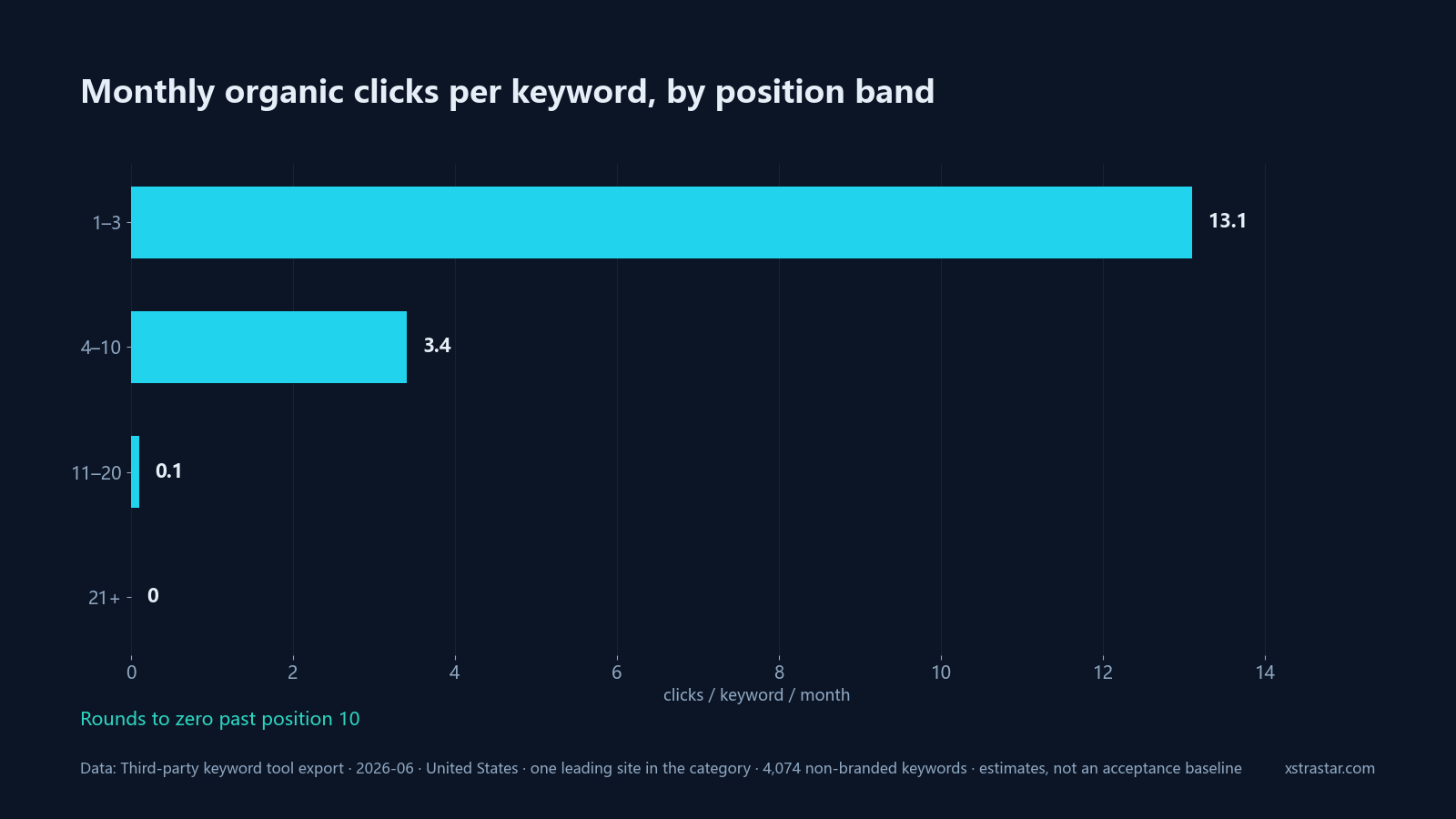
In the AI search category, organic clicks sit almost entirely in the top 10. A per-keyword study found an average of 13.1 monthly clicks for keywords ranking 1–3, 3.4 for 4–10, 0.1 for 11–20, and 0.0 beyond position 21.
That distribution has one planning consequence: the unit of measurement is the number of pages inside the top 10, not the number of pages published.
The data
Third-party keyword tool export, 2026-06, United States, one leading site in this category, 4,074 non-branded keywords, 11,864 organic clicks per month in total.
| Position band | Monthly clicks per keyword |
|---|---|
| 1 – 3 | 13.1 |
| 4 – 10 | 3.4 |
| 11 – 20 | 0.1 |
| 21+ | 0.0 |
The blunter cut of the same data: the 2,770 keywords ranking below position 10 produced 43 clicks combined.
Caveat on the figures: these are third-party estimates, labelled by tool type, date and region. They are useful for order of magnitude and structure, and unsuitable as an acceptance baseline. They are never merged with first-party measurement.
Why the decay is steeper here than in most categories
- Generated summaries compress the list. When an AI summary appears above the results, link clicks in the list below drop measurably (Pew Research Center, 2025-07-22). Compression hits the whole list, and the lower half hardest.
- The queries are decision-shaped. People ask which vendor, how to choose, how much it costs. Enough signal arrives in the first few results that scrolling stops early.
- The candidate set is small. A generated answer typically cites a handful of sources, and a page at position 11 rarely enters that set.
What changes in the plan
| Common practice | What the distribution argues for |
|---|---|
| Schedule by output: N pages per week | Schedule by band: move M pages from 11–20 into 4–10 |
| Report indexed pages and pages shipped | Report pages inside the top 10, plus band distribution over time |
| Rank topics by search volume | Rank topics by volume weighted by realistic odds of reaching the top 10 |
⚠️ One exception belongs in the same breath: a page below position 10 is not a worthless page. It can still be cited by a generated answer, because citation and ranking are two different mechanisms, and it still carries internal links and entity consistency. This distribution constrains organic clicks only.
Carrying capacity beats page count
In the same dataset those 11,864 monthly clicks were carried by 162 URLs. Traffic came from a small number of pages reaching the top 10, not from the size of the library.
One action available immediately: group existing pages into the four bands and count pages and clicks per band. When the 11–20 band holds far more pages than the top 10 does, the next cycle belongs to promotion work, not to new pages.
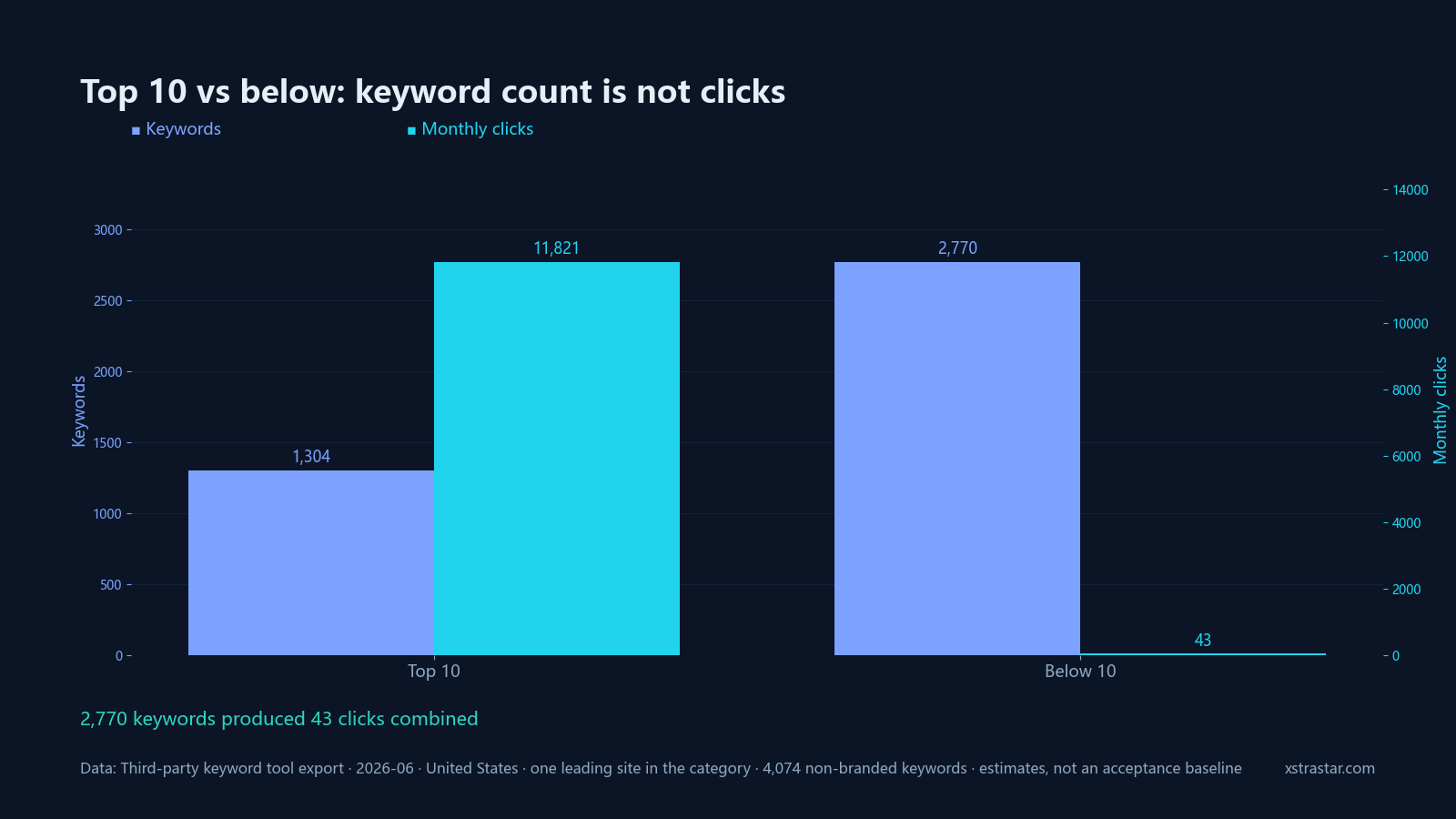
Key takeaway: Organic clicks in the AI search category concentrate in the top 10. A 2026-06 third-party per-keyword study (United States, 4,074 non-branded keywords, 11,864 monthly clicks) shows 13.1 monthly clicks per keyword at positions 1–3, 3.4 at 4–10, 0.1 at 11–20 and 0.0 beyond 21, with the 2,770 keywords below position 10 producing 43 clicks combined and all clicks carried by 162 URLs. Content programmes should therefore be measured by pages inside the top 10 and by band movement, not by pages published. The constraint applies to organic clicks; citation in generated answers follows a separate mechanism.
Related: Position bands decide priority | Long tail before head terms | Impressions vs clicks | How to measure GEO
Sources: Position bands and click distribution from a third-party keyword tool export (2026-06, United States, one leading site in the category, 4,074 non-branded keywords); estimates, not an acceptance baseline. Summary impact on clicks from Pew Research Center, Google users are less likely to click on links when an AI summary appears (2025-07-22).
Last updated: 2026-08-27
Turn insight into growth
Find your next AI search growth opportunity
From brand visibility and citation sources to content strategy, the XstraStar team will help you map a clear, measurable GEO optimization path.
Talk to a GEO advisorAbout the author
XstraStar Editorial Team
GEO Research & Strategy
The XstraStar editorial team studies AI search, generative engine optimization, and brand visibility, turning platform mechanics, field experience, and market shifts into practical growth guidance.
Related insights