What Chinese AI Search Actually Cites: Two First-Party Measurements

XstraStar Editorial Team
GEO Research & Strategy

In this article
For the same class of Chinese decision question, domestic AI platforms draw on listicle-style articles published by news outlets, while ChatGPT draws on paper repositories, community discussion and tools that open and return a result. The two ecosystems accept different kinds of evidence, and one content asset does not cover both.
Two terms first. A cited source is an entry an AI answer lists as the basis for its conclusion. A candidate set is the batch of pages retrieved before the answer gets written, usually a handful to a dozen or so; a page outside that batch never appears in the answer.
Method
| Measurement | Window | Platforms | Questions | Cited sources | Note |
|---|---|---|---|---|---|
| A | 2026-05-28 | Doubao / DeepSeek / Tongyi Qianwen | 16 | 440 | Qianwen returned 0 URLs, only titles, publishers and snippets |
| B | 2026-07-16 to 2026-08-14 | ChatGPT, prompted in Chinese | 8 | 214 across 75 domains | Single platform |
The two measurements differ in question set, window and platforms, so every proportion below holds only inside its own sample. No addition, no merging, no cross-measurement comparison of magnitude.
Counting rule: one cited source equals one source given by one platform in the answer to one question. An article cited for several questions counts several times. Multiple domain forms of one publisher (desktop and mobile editions, for example) are counted as one publisher and not de-duplicated by domain.
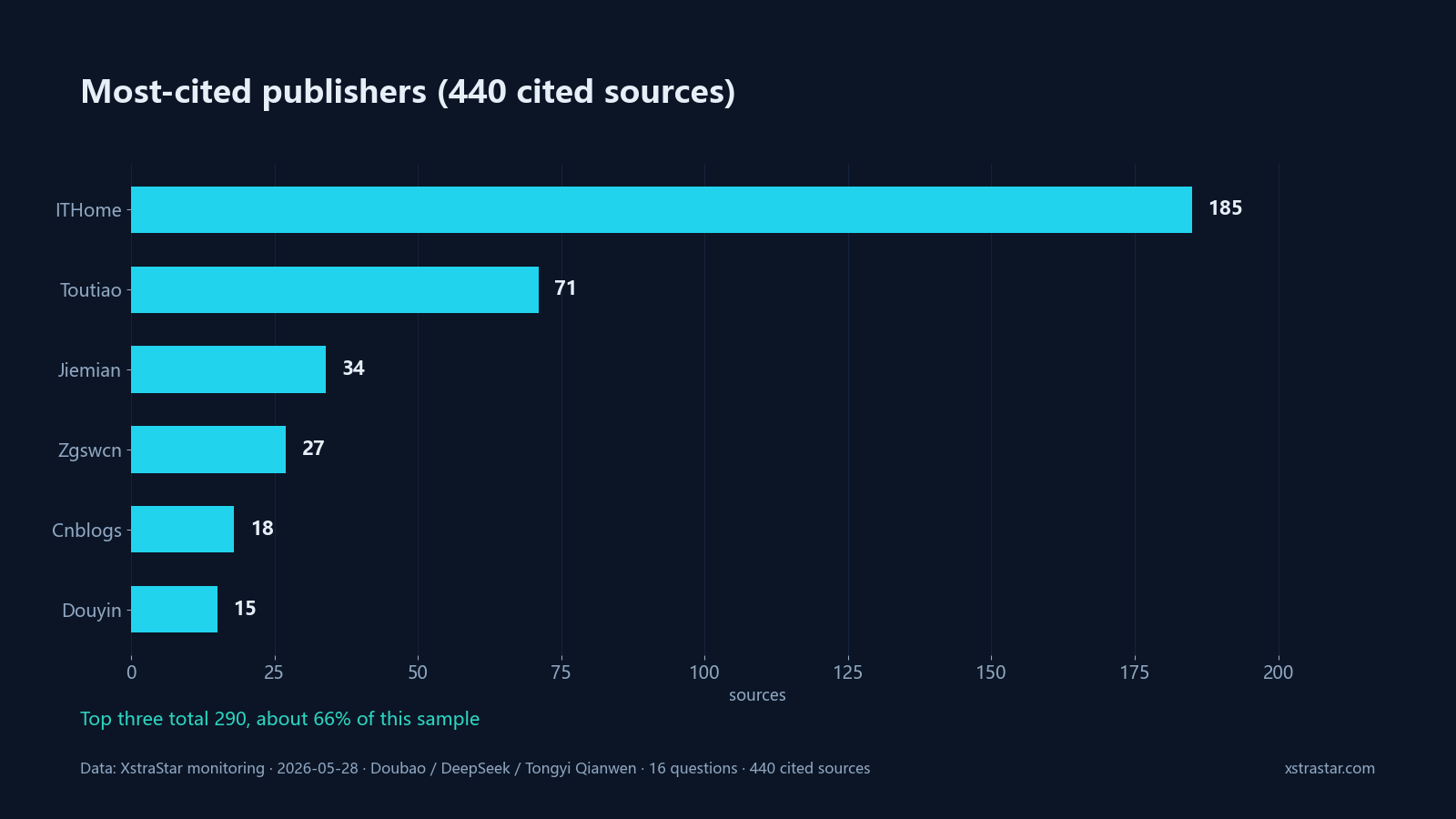
Domestic platforms: a handful of news publishers
Measurement A, 440 sources by platform: Doubao 203, DeepSeek 125, Qianwen 112.
By publisher, the leaders are ITHome 185, Toutiao 71, Jiemian 34, Zgswcn 27, Cnblogs 18, Douyin 15. The top three account for 290 sources, roughly 66% of this sample.
Platform preferences separate clearly: Doubao leans toward mobile news feeds and content platforms, DeepSeek concentrates on several domain forms of one tech publisher plus industry-observer media, and Qianwen stays with standard desktop pages from two publishers.
The implication for placement: short-term visibility on the Chinese side rests on a small number of sources, so channels should be ranked by measured citation volume and not by publisher prestige.
What kind of article gets cited: 73% are listicles
The same 440 sources, classified by title format:
| Title format | Count | Share |
|---|---|---|
| Listicle / ranking | 321 | 73.0% |
| Review / comparison | 58 | 13.2% |
| Selection guide | 28 | 6.4% |
| Report / whitepaper | 8 | 1.8% |
| Case study / results | 2 | 0.5% |
| Other | 23 | 5.2% |
Listicle titles took over seven in ten citation slots, because they answer the question as asked: which vendor, what ranking, who the leaders are. A model needs a conclusion it can lift directly.
The last two rows deserve a second look. Case-study titles appear twice, 0.5% of the sample. Case material is a trust asset in a sales conversation and carries almost no weight in citation, so treating case articles as the main lever for citation points in the wrong direction.
Inside the body: cited articles are composite packages
Of the cited sources, 30 article records were retrieved and 28 carried full body text. Their structural signals line up: 28 with ranking signals, 27 with review or comparison, 27 with selection guidance or FAQ, 27 with report or research framing, 25 with scoring or ratings, 10 using whitepaper language.
Not one of the 28 was single-format. Cited articles supply four things at once: a conclusion entry point (a ranking or a stated verdict), grounds for comparison (scores, metrics, quantities), a reason to recommend (side-by-side review) and intent matching (selection questions and FAQ). Missing any one of them leaves a model with half an answer.
One mechanical limit belongs here: the citation value of a listicle comes from third-party standing. Where the publisher sits inside the candidate scope, that third-party quality no longer holds, and Chinese-language pages additionally fall under advertising-law constraints on unprovable ranking claims. Such content therefore lands on third-party sites, while owned domains carry method, data and conversion pages.
ChatGPT in Chinese draws on another set
Measurement B spread 214 sources across 75 domains. The largest share belongs to arxiv.org: 48 of 214, about 22%, followed by reddit.com at 19. The remainder scatters across English SEO and marketing publishers, official developer documentation, vendor sites in the same category, and online self-check tools.
Three points:
- Papers lead. This side accepts verifiable method and experiment over publisher authority, so a method description needs sample size, window and adjudication rules to hold a position.
- Community discussion enters the citation set. Genuine practitioner conversation carries weight, and that signal cannot be bought.
- Tools that work get cited. A page returning a result on opening travels into answers more readily than an article describing the same thing, which matters more for a product company than ten additional articles.
Two evidence systems, side by side
| Dimension | Chinese platforms (A) | ChatGPT in Chinese (B) |
|---|---|---|
| Primary evidence | News-publisher articles | Papers, community discussion, working tools, official docs |
| Effective format | Listicles, reviews, selection guides | Method and experiment, real discussion, interactive pages |
| Landing place | Third-party publishers | Owned method and tool pages, plus English communities |
| Verifiable against source | Some platforms return no URL | URLs returned, originals checkable |
This table describes structural difference, not difference in magnitude.
The measurement fact most easily skipped
In Measurement A, the 112 Qianwen sources carried no URL at all, only title, publisher and snippet. Publisher frequency and title-format statistics work there; returning to the original page does not.
Any cross-platform citation-share total has to state that gap first. Merging unverifiable samples with verifiable ones produces a figure that looks more complete and holds less.
Four things to do with this
- Rank Chinese channels by measured citation volume. Pull the citation-source distribution for the category first, then choose publishers. Re-measure quarterly, because the order moves.
- Write all four modules into one article: conclusion entry point, grounds for comparison, reason to recommend, selection questions and FAQ.
- On the English and bilingual side, prioritise two assets: method descriptions carrying stated sample sizes, and self-check pages that work.
- Report the two datasets separately. Any difference in question set, window or platform means separate presentation, and platforms without source URLs get labelled as such.

Key takeaway: Two 2026 first-party measurements show Chinese AI platforms and ChatGPT accepting different evidence for the same class of Chinese decision question. Across three domestic platforms (Doubao, DeepSeek, Tongyi Qianwen; 16 questions, 440 cited sources) citations concentrate in a few news publishers, with the top three at roughly 66%, listicle and ranking titles at 73.0% of sources, and cited articles carrying rankings, scores, side-by-side review and selection FAQ simultaneously. For ChatGPT prompted in Chinese (8 questions, 214 sources, 75 domains) the most-cited source is a paper repository at about 22%, followed by community discussion and online tools that return a result. The two ecosystems require separately built content assets, and the two measurements differ in method and cannot be combined.
Related: Chinese vs English sources | Chinese platform roles | Why AI cites what it cites | Original data as citation bait | Cited source mix | Doubao citations
Sources: Both measurements are first-party data from the XstraStar monitoring platform. Measurement A: 2026-05-28, Doubao, DeepSeek and Tongyi Qianwen, 16 Chinese decision questions, 440 valid cited sources, 30 cited-article records of which 28 carried body text. Measurement B: 2026-07-16 to 2026-08-14, ChatGPT prompted in Chinese, 8 questions, 214 cited sources across 75 domains. The two differ in method and are never combined.
Last updated: 2026-08-27
Turn insight into growth
Find your next AI search growth opportunity
From brand visibility and citation sources to content strategy, the XstraStar team will help you map a clear, measurable GEO optimization path.
Talk to a GEO advisorAbout the author
XstraStar Editorial Team
GEO Research & Strategy
The XstraStar editorial team studies AI search, generative engine optimization, and brand visibility, turning platform mechanics, field experience, and market shifts into practical growth guidance.
Related insights