Three Reasons A Product Stays Invisible In ChatGPT
"Asked around and the answer never mentions the product" has three distinct causes: the crawl layer never opened, content format does not match how people ask…

XstraStar Editorial Team
GEO Research & Strategy

In this article
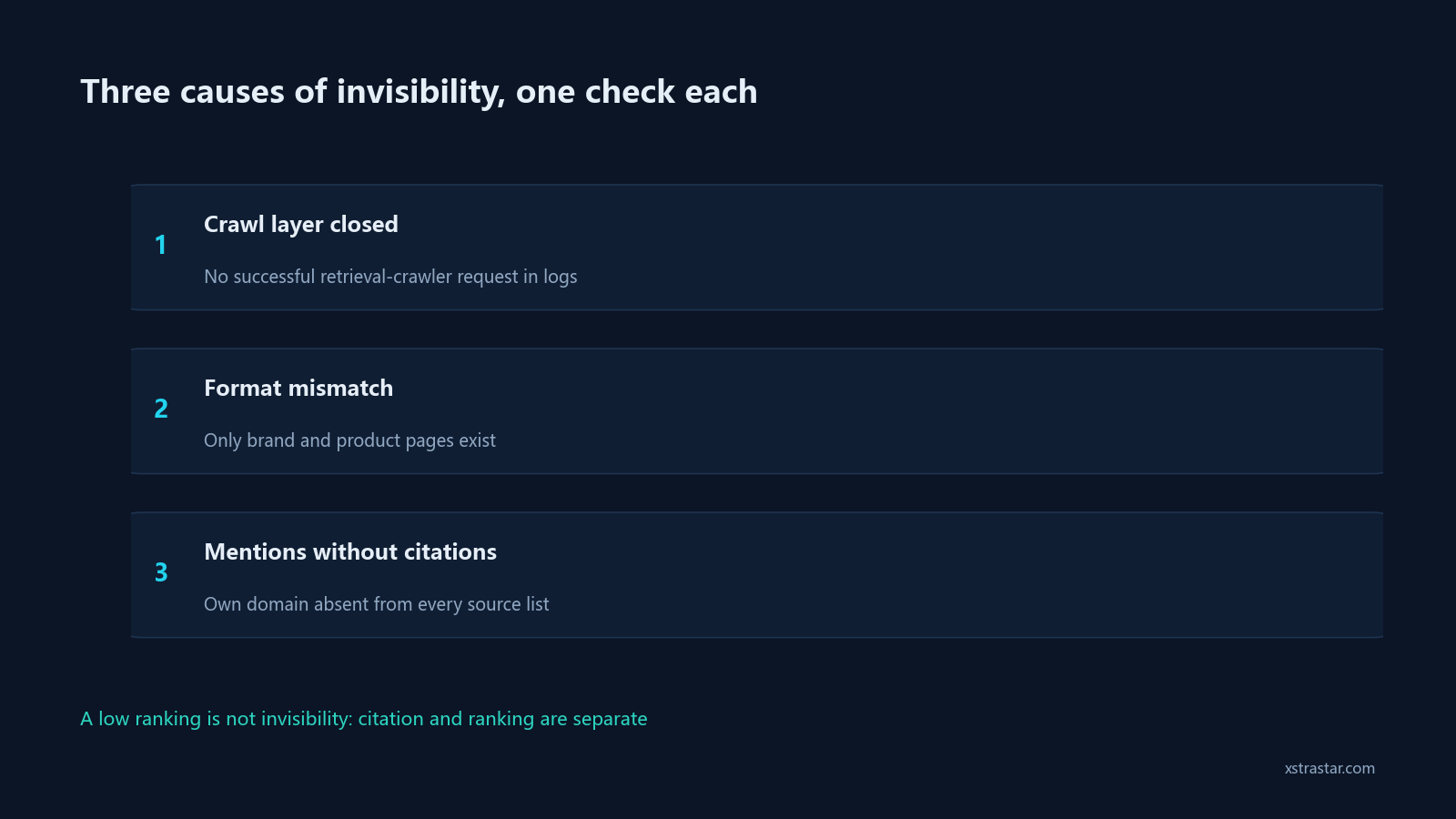
"Asked around and the answer never mentions the product" has three distinct causes: the crawl layer never opened, content format does not match how people ask, or the brand reaches the answer text while the site never reaches the source list. All three look identical in the output and call for different work, so locate first.
Each cause takes one check, and all three fit inside a day.
Cause 1: the crawl layer never opened
When retrieval crawlers cannot reach content, page quality changes nothing, because the page never enters the candidate set.
Check: read server logs for retrieval-crawler requests and response status, and confirm complete HTML came back. Three places usually break it: a gateway or security service blocking by user agent, page content rendered client-side while the server returns a shell, and training crawlers allowed while retrieval crawlers stay blocked.
Verdict: no successful retrieval-crawler request in the logs means this cause.
⚠️ When this layer looks fine, do not use front-end analytics to prove a crawler arrived. Crawlers that execute no JavaScript never appear there.
Cause 2: content format does not match the questions
Pages are reachable, and what sits on them does not answer what people ask.
Third-party per-keyword export (2026-06, United States, one leading site in this category, 4,074 non-branded keywords, 11,864 monthly organic clicks):
| Format | Share of clicks |
|---|---|
| Listicles / selection (which vendor, how to choose, what exists) | 44% |
| Metrics / measurement (how to measure, how to compute) | 14% |
| Glossary / definitions | 3% |
| Everything else | 1%–2% each |
Check: classify the question pool by format, then look for matching page formats on the site. Where only brand and product pages exist, "how to choose" and "how to measure" questions find no usable material in the candidate set.
Verdict: site pages concentrated in brand and product material while the pool is mostly decision-stage questions means this cause.
Cause 3: the brand reaches the answer, the site does not reach the sources
The answer names the brand and cites somebody else's page. That visibility rests on another party's content, produces no clicks, and gets replaced as soon as stronger evidence appears.
Check: list the cited sources across the same batch of answers and look for the site's own domain.
Verdict: mentions present, own domain absent from every source list. The gap here is citable material: data with a stated method, conclusions that lift out whole, structured comparison tables.
Action and horizon per cause
| Cause | First action | Time to visible change |
|---|---|---|
| Crawl layer closed | Fix allow rules and server rendering, re-verify with logs | Immediate once fixed; indexation separate |
| Format mismatch | Add formats by pool, decision-stage first | One content cycle, bounded by indexing |
| Mentions without citations | Restructure existing pages for extraction; add verifiable first-party data | Slower, and needs corroboration across sources |
One thing that is not a cause
A low ranking does not equal invisibility. A page below position 10 can still be cited, because citation and ranking run on separate mechanisms. The reverse also happens: a page inside the top 10 while answers still omit the brand. Diagnose invisibility from answer-side collection, never from rankings.
⚠️ Three collection rules apply: sample each question several times because single runs move, adjudicate with literal and semantic checks together because tabular answers glue brand names to adjacent text and word-boundary matching misses them, and remember that platforms withholding source URLs cannot support page-level attribution.
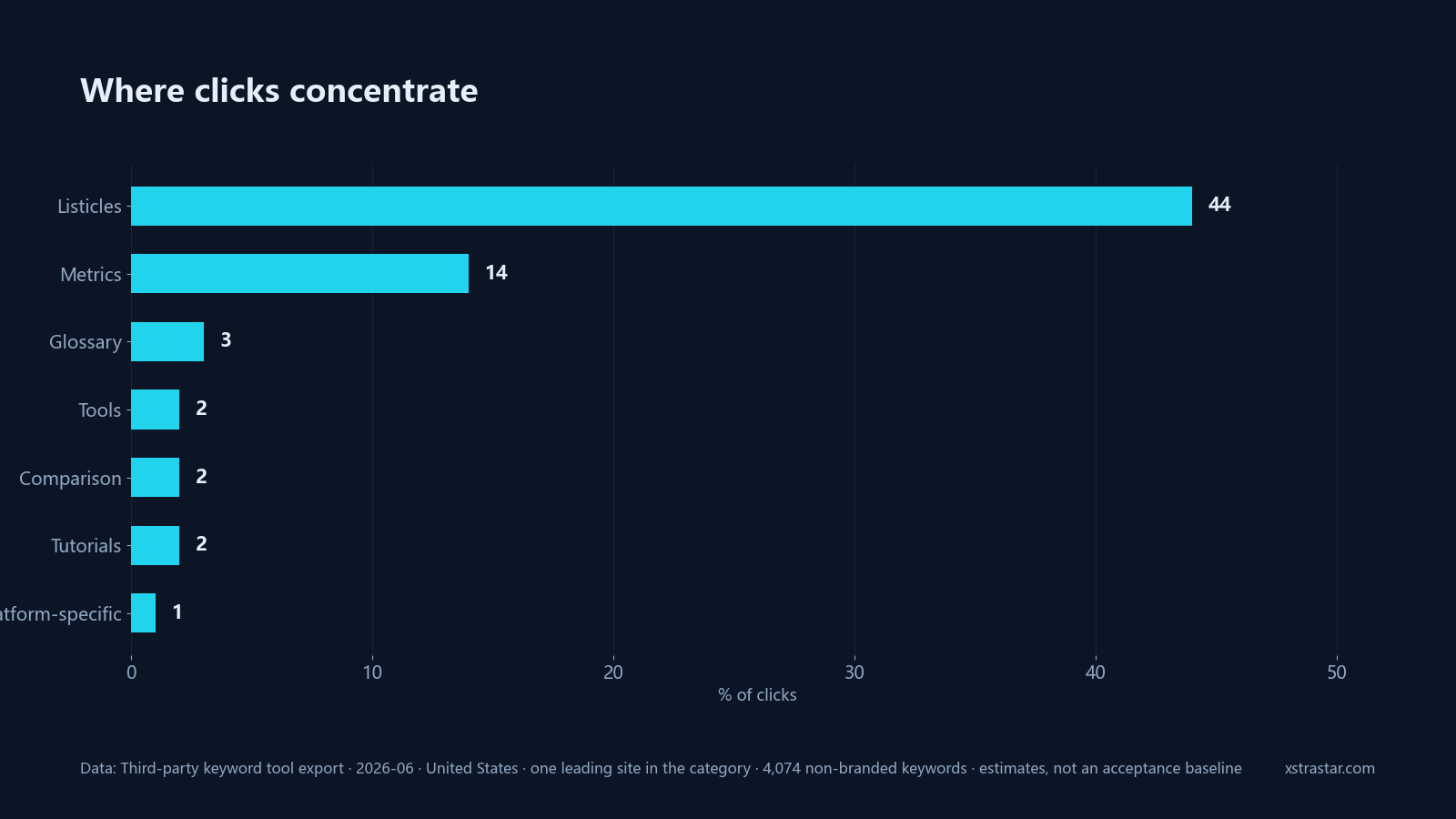
Key takeaway: Invisibility in generative answers has three causes with different checks. First, a closed crawl layer (verdict: no successful retrieval-crawler request in server logs; front-end analytics cannot prove crawler arrival), which resolves as soon as it is fixed. Second, format mismatch (verdict: site pages concentrated in brand and product material while the question pool is decision-heavy) — third-party data shows category clicks concentrated in listicle and selection formats at 44% and metrics at 14%, with glossary at 3%. Third, brand mentions without citations (verdict: own domain absent from every source list), where citable material is the gap. A low ranking is not a cause, because citation and ranking are separate mechanisms; diagnose from answer-side collection.
Related: How AI picks answers | Why AI cites what it cites | Crawlability first | ChatGPT citations | Answer inclusion rate
Sources: Format and click distribution from a third-party keyword tool export (2026-06, United States, one leading site in the category, 4,074 non-branded keywords); estimates, not an acceptance baseline. Diagnostic method and collection rules from XstraStar monitoring practice.
Last updated: 2026-08-27
Turn insight into growth
Find your next AI search growth opportunity
From brand visibility and citation sources to content strategy, the XstraStar team will help you map a clear, measurable GEO optimization path.
Talk to a GEO advisorAbout the author
XstraStar Editorial Team
GEO Research & Strategy
The XstraStar editorial team studies AI search, generative engine optimization, and brand visibility, turning platform mechanics, field experience, and market shifts into practical growth guidance.
Related insights