Platform-Specific Pages Are The Emptiest Slot In This Category
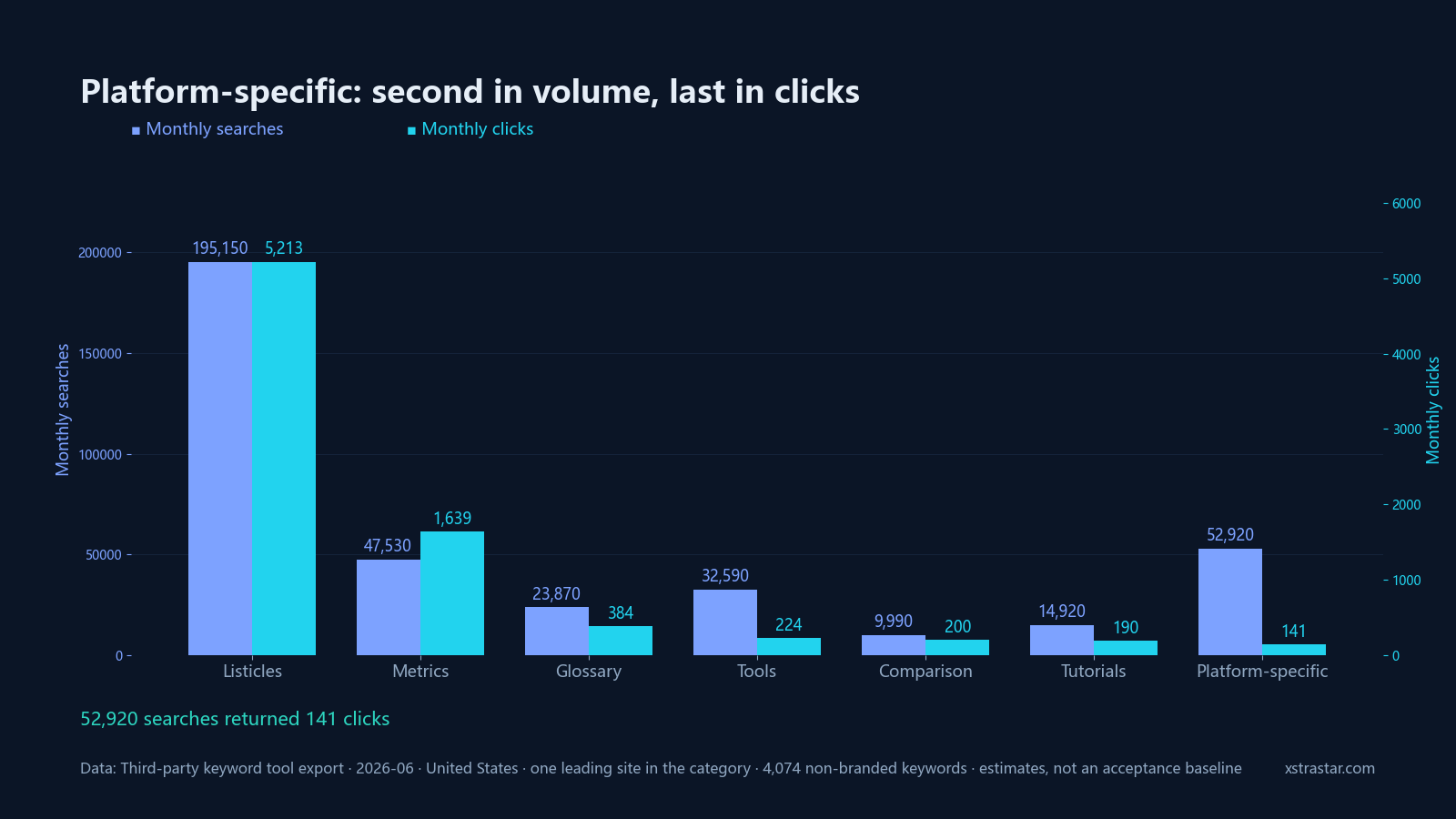
In one per-keyword study, platform-specific keywords numbered 307 with 52,920 monthly searches, and collected 141 clicks — 1% of all non-branded clicks.

XstraStar Editorial Team
GEO Research & Strategy

In this article
In one per-keyword study, platform-specific keywords numbered 307 with 52,920 monthly searches, and collected 141 clicks — 1% of all non-branded clicks. Second-highest search volume, last place in clicks. That is a supply gap.
The gap deserves its own slot in the plan, with one precondition: without measured data for the platform in question, such a page can only be written as generic guidance, and generic guidance does not reach the top 10.
The numbers
Third-party keyword tool export, 2026-06, United States, one leading site in this category, 4,074 non-branded keywords.
| Format | Keywords | Monthly searches | Monthly clicks | Share | Avg. difficulty |
|---|---|---|---|---|---|
| Listicles / selection | 1,060 | 195,150 | 5,213 | 44% | 23 |
| Platform-specific | 307 | 52,920 | 141 | 1% | 32 |
| Metrics / measurement | 265 | 47,530 | 1,639 | 14% | 25 |
| Tools / free utilities | 169 | 32,590 | 224 | 2% | 26 |
Three readings:
- Search volume and clicks have come apart. Platform-specific volume (52,920) exceeds metrics (47,530), while its clicks stay under a tenth of the metrics figure (141 against 1,639).
- Difficulty is the highest in the table (32). An empty slot is not an easy slot; competition here comes from platform documentation and large publishers.
- 307 keyword slots map to four page types across several platforms. One page cannot cover it; the shape is a platform × page-type matrix.
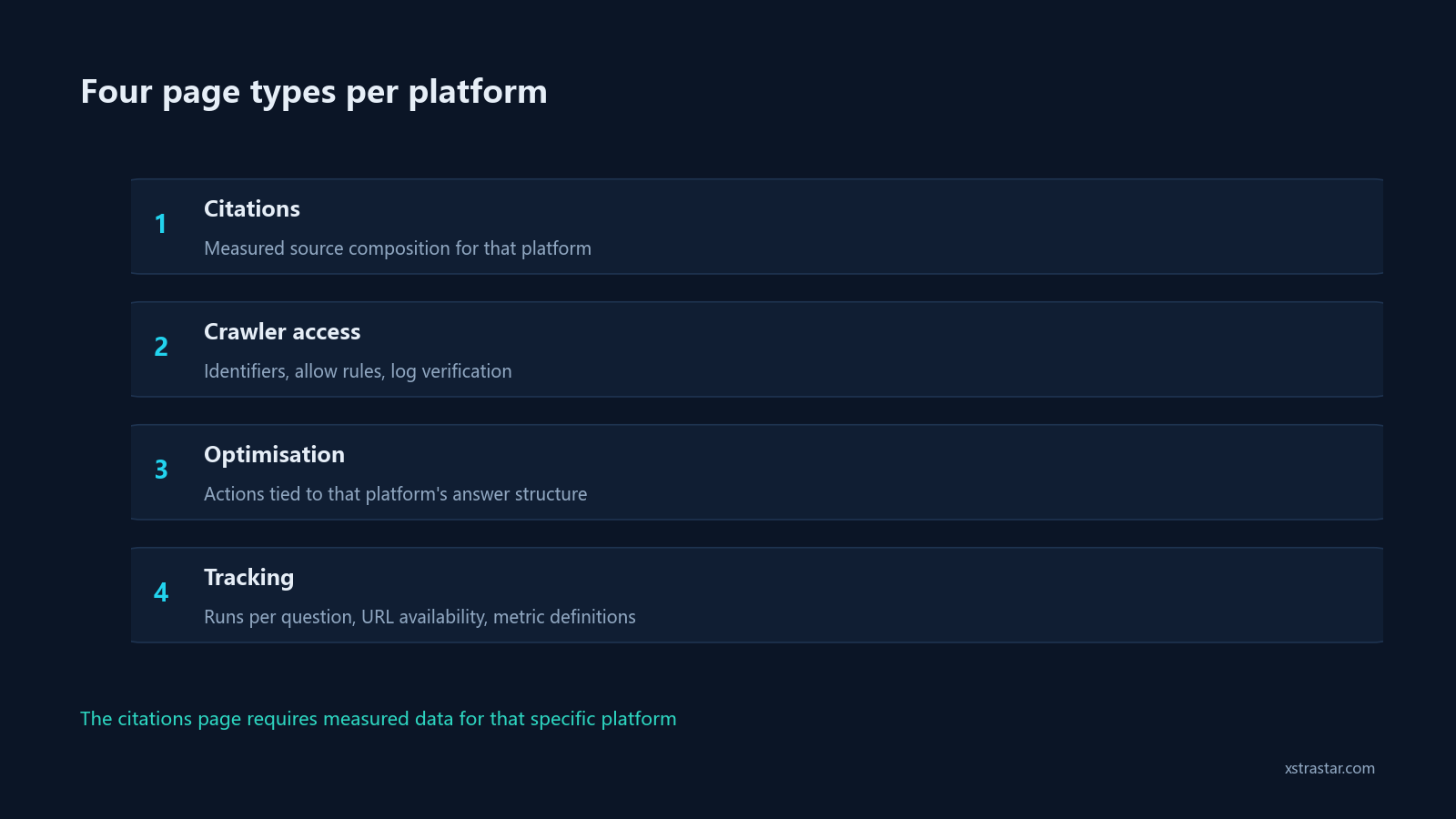
The four page types per platform
| Page type | Question answered | Required content |
|---|---|---|
| Citations | What kinds of sources this platform cites | Measured source composition for that platform, with collection window and question count |
| Crawler access | What the crawler is called and how to allow it | Crawler identifiers, allow-rule syntax, verification method (logs) |
| Optimisation | What to do for this platform | Concrete actions tied to that platform's answer structure |
| Tracking | How to monitor this platform | Runs per question, whether source URLs are returned, metric definitions |
⚠️ The Citations page is the hardest of the four, because it requires measured data. Writing it without measurement produces conclusions borrowed from another platform, and source ecosystems differ enough between platforms that borrowed conclusions come out wrong.
Preconditions before scheduling
In order; a missing item pushes the page back:
- The platform is already in the collection chain: fixed question pool, repeated sampling, answers and sources stored.
- Source availability is known: whether that platform returns source URLs. Where it does not, the Citations page stops at publisher level and says so on the page.
- Crawler identifiers and a verification method are confirmed. Errors here cost the most, because readers copy the configuration.
- Metric definitions exist: runs per question and denominators stated, so any percentage on the page reproduces.
Which platforms come first
Order by two quantities, not by platform fame:
- Measured citation volume: which platform cites the site's own question pool most often.
- Target-market usage: cover the platforms that matter in the market being sold into. Chinese-market and English-market platform lists differ, so schedule the two separately.
⚠️ A common ordering mistake is "start with the most famous one". Fame and citation volume inside a specific category are different quantities, and one collection run settles the order cheaply.
Key takeaway: Platform-specific pages are the least-supplied format in this category. A 2026-06 third-party per-keyword export (United States, one leading site in the category, 4,074 non-branded keywords) shows 307 platform-specific keywords with 52,920 monthly searches, above the 47,530 of metrics keywords, yet only 141 clicks or 1% of non-branded clicks, under a tenth of the metrics figure, at the highest average difficulty in the table (32). Each platform needs four page types: citations, crawler access, optimisation and tracking, and the citations page requires measured data for that specific platform, since source ecosystems differ too much for borrowed conclusions. Preconditions: the platform is in the collection chain, source-URL availability is known, crawler identifiers and verification are confirmed, and metric definitions are stated. Order platforms by measured citation volume and target-market usage, not by fame.
Related: Chinese platform roles | Retrieval vs training crawlers | ChatGPT citations | Doubao citations | DeepSeek citations
Sources: Keyword counts, search volume, clicks and difficulty from a third-party keyword tool export (2026-06, United States, one leading site in the category, 4,074 non-branded keywords); estimates, not an acceptance baseline. Page types and preconditions from XstraStar delivery practice.
Last updated: 2026-08-27
Turn insight into growth
Find your next AI search growth opportunity
From brand visibility and citation sources to content strategy, the XstraStar team will help you map a clear, measurable GEO optimization path.
Talk to a GEO advisorAbout the author
XstraStar Editorial Team
GEO Research & Strategy
The XstraStar editorial team studies AI search, generative engine optimization, and brand visibility, turning platform mechanics, field experience, and market shifts into practical growth guidance.
Related insights