Free Self-Check Pages: An Underrated Entry Point
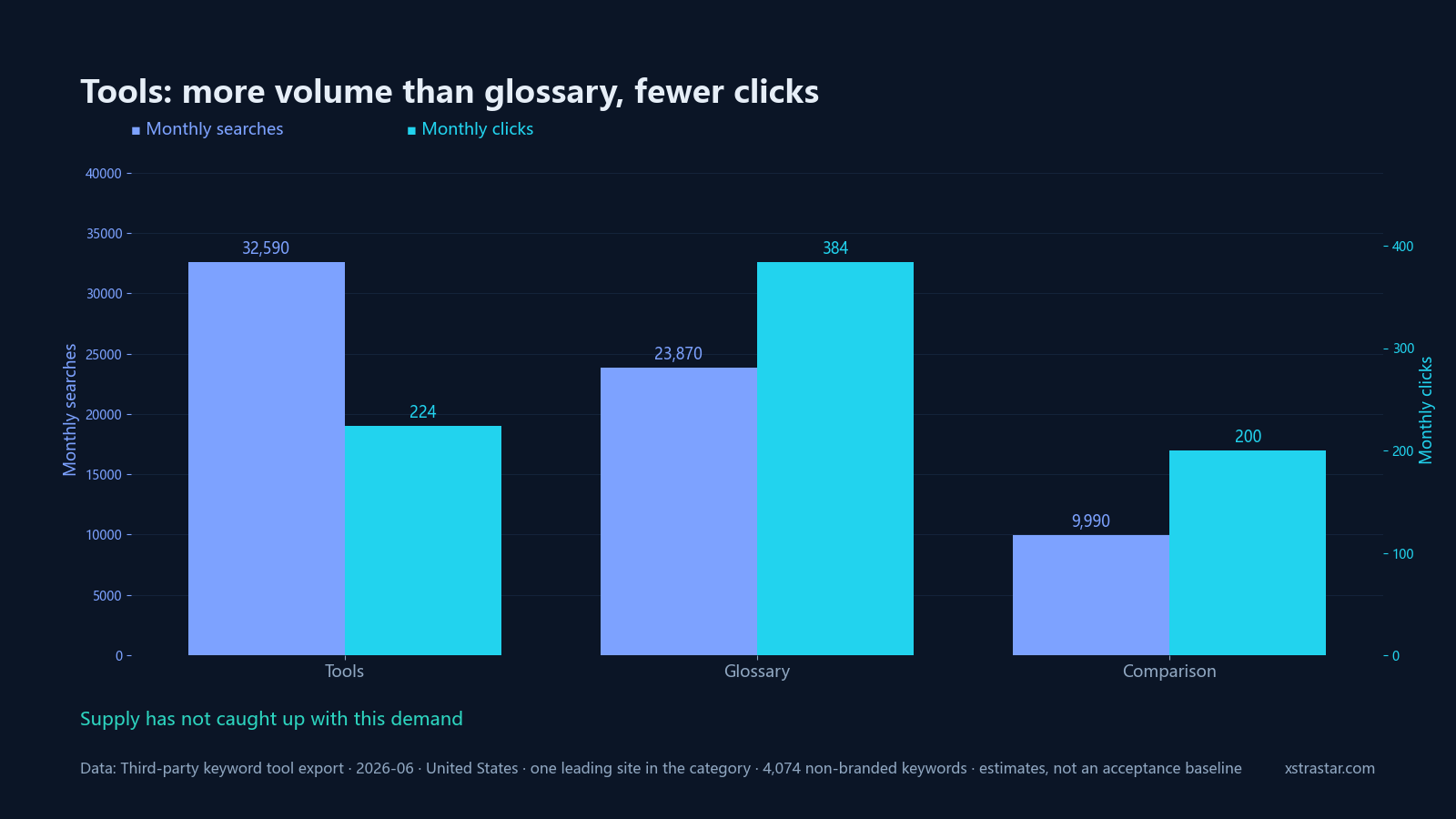
Tool keywords in this per-keyword study number 169 with 32,590 monthly searches, and collect 224 clicks.

XstraStar Editorial Team
GEO Research & Strategy

In this article
Tool keywords in this per-keyword study number 169 with 32,590 monthly searches, and collect 224 clicks. Their value sits elsewhere: marginal cost approaches zero after one build, the page carries enquiry intent by itself, and something usable on the spot gets lifted into answers more readily than an article describing the same thing.
Worth building, on one condition: build it as a tool, not as an article with a form attached.
Where the numbers sit
Third-party keyword tool export, 2026-06, United States, one leading site in this category, 4,074 non-branded keywords.
| Format | Keywords | Monthly searches | Monthly clicks | Avg. difficulty |
|---|---|---|---|---|
| Tools / free utilities | 169 | 32,590 | 224 | 26 |
| Glossary / definitions | 120 | 23,870 | 384 | 33 |
| Comparison pages | 80 | 9,990 | 200 | 19 |
Tool keywords carry more search volume than glossary keywords and collect fewer clicks, which points at supply lagging demand. Difficulty sits mid-table at 26, below glossary at 33.
Three things other formats cannot offer
Marginal cost. An article costs its full price every time. A tool costs mostly once. A working self-check page carries far lower maintenance than an article matrix producing comparable traffic.
Built-in enquiry intent. Someone entering a site or brand name to check something has already declared intent. ⚠️ The condition: keep results in front of the form. Show a usable result first, then offer the full version. Pages that lock everything behind a form raise bounce rate and complaints together.
Usability as a citation reason. A page that returns a result on opening gets written into answers more readily than an article about the same subject, because it is an executable next step for the person asking.
Four hard requirements
| Requirement | Why |
|---|---|
| First result without registration | A registration wall in front of the result loses this intent wholesale |
| Explainable results, never a bare score | A bare score supports no action and no citation; state why each item reads the way it does |
| Method printed on the page | What was checked, on what criteria, when the data was collected. A score without method collapses under one follow-up question |
| A path toward the deeper service | Self-check answers whether a problem exists; fixing it is the service entry point |
Three ways it gets built wrong
- Building a form. Eight fields before a result loses people by field three. Fewer inputs is better, and one is the target.
- Every result concludes "problems found, contact us". Readers see through it quickly, and answers stop citing it. Results have to be honest, including "this item is fine".
- No evidence trail. A verdict with no visible working leaves nothing to verify. Showing intermediate results (which URL was checked, what status came back, which section was missing) raises credibility and citation odds together.
Scheduling note
Glossary pages explain concepts and tool pages return verdicts, and cross-linking the two lifts both. In scheduling terms, a tool page outranks additional glossary pages, because glossary difficulty in this dataset (33) is the highest in the table while tools sit at 26.
⚠️ One precondition: a tool page needs development capacity and somebody watching its error logs afterwards. Without both, publish a checklist page that a reader can work through manually. It is not a tool, it absorbs part of the same intent, and it can be upgraded later.
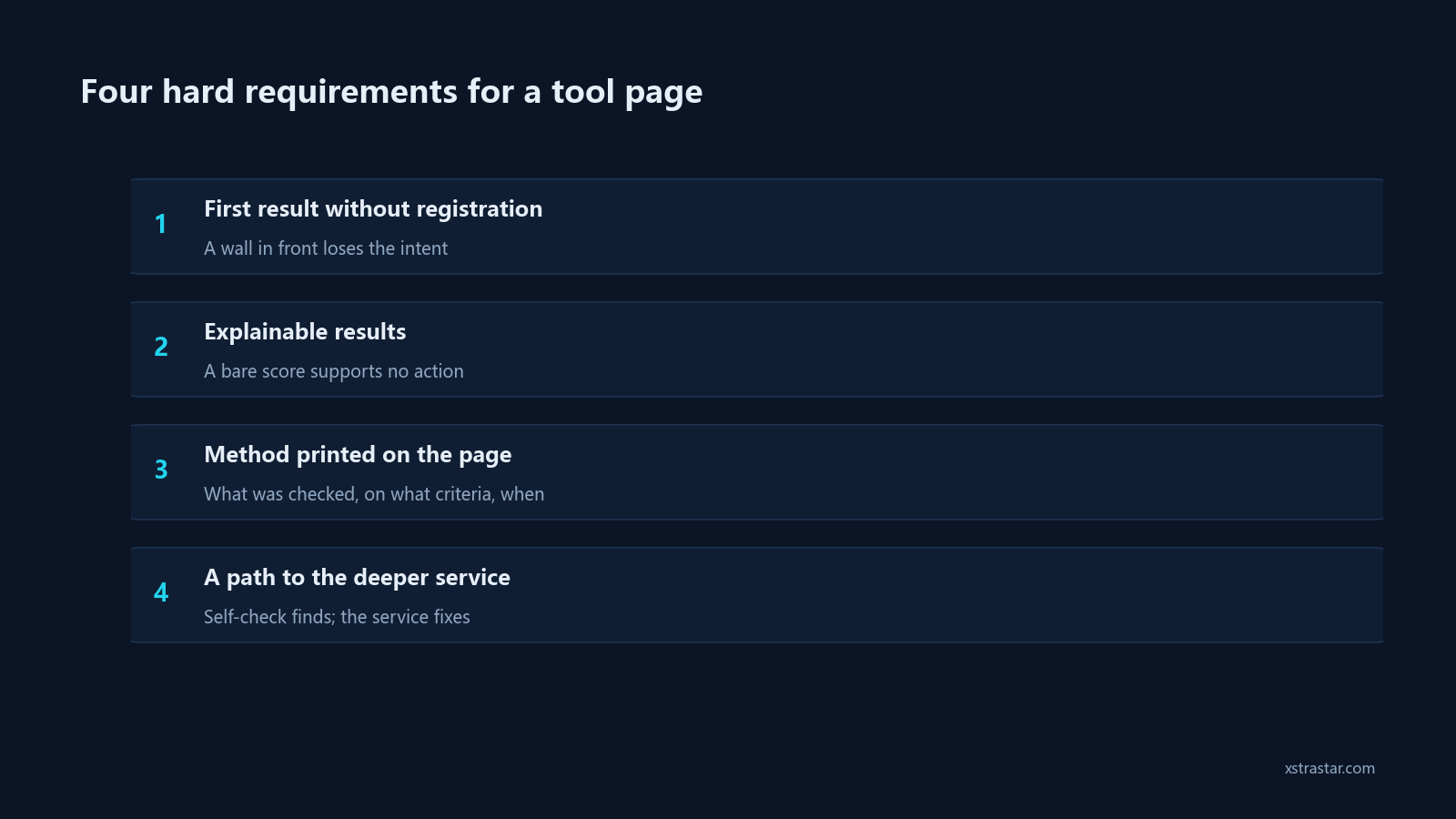
Key takeaway: Free self-check and tool pages are under-supplied in this category. A 2026-06 third-party per-keyword export (United States, one leading site in the category, 4,074 non-branded keywords) shows 169 tool keywords with 32,590 monthly searches, above the 23,870 of glossary keywords, collecting only 224 clicks, at average difficulty 26 against glossary at 33. Value comes from three properties: marginal cost near zero after one build, built-in enquiry intent, and usability as a reason to be cited. Four requirements: a first result without registration, explainable results instead of a bare score, method printed on the page, and a path to the deeper service. Three failure modes: building a multi-field form, results that always conclude with a sales prompt, and verdicts with no verifiable working.
Related: Page type matrix | Glossary as foundation | AI visibility audit | Conversion from AI
Sources: Keyword counts, search volume, clicks and difficulty from a third-party keyword tool export (2026-06, United States, one leading site in the category, 4,074 non-branded keywords); estimates, not an acceptance baseline. Requirements and failure modes from XstraStar site and project practice.
Last updated: 2026-08-27
Turn insight into growth
Find your next AI search growth opportunity
From brand visibility and citation sources to content strategy, the XstraStar team will help you map a clear, measurable GEO optimization path.
Talk to a GEO advisorAbout the author
XstraStar Editorial Team
GEO Research & Strategy
The XstraStar editorial team studies AI search, generative engine optimization, and brand visibility, turning platform mechanics, field experience, and market shifts into practical growth guidance.
Related insights