A Multilingual Site Needs Three Jobs. Translation Is One
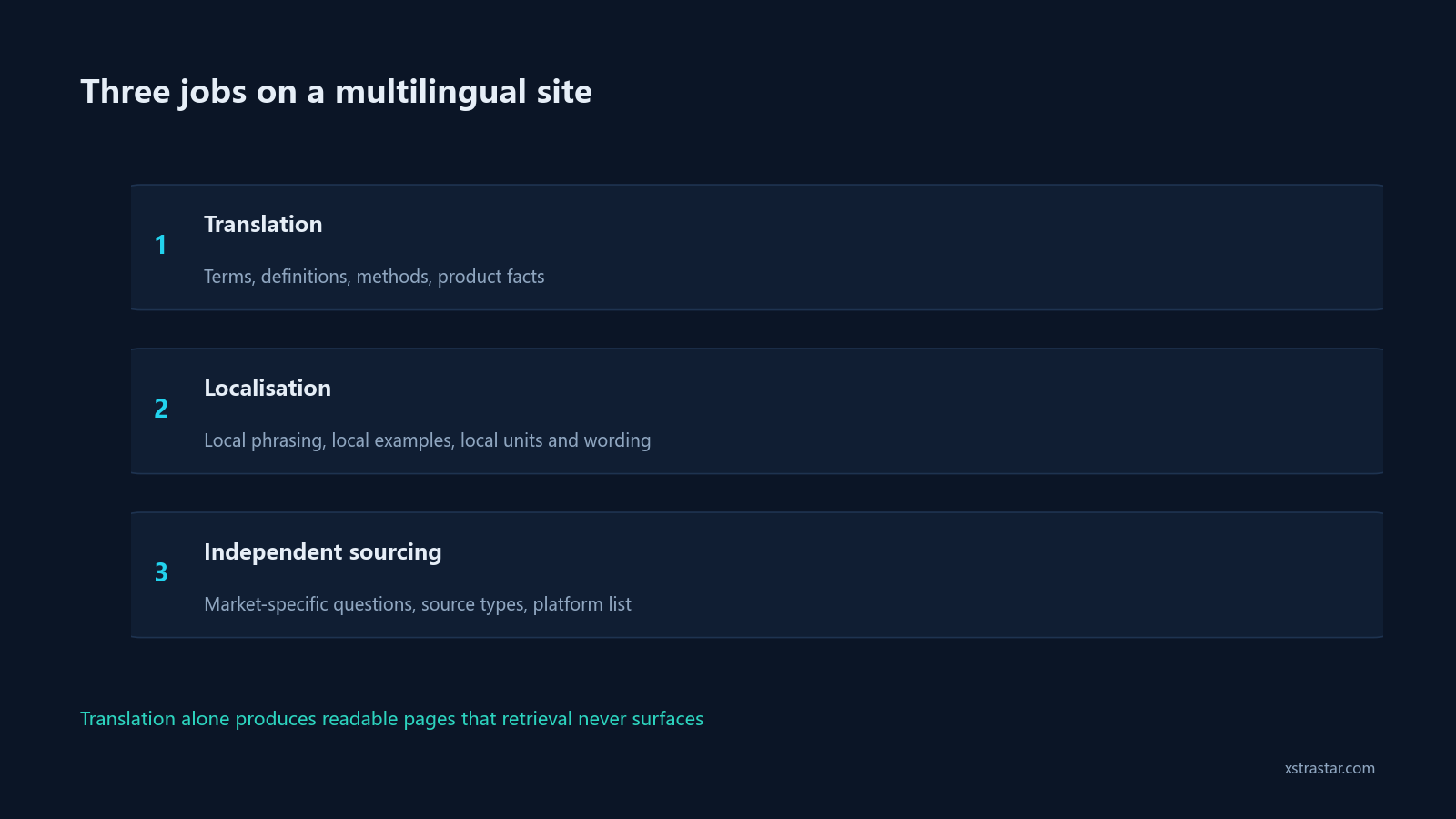
Visibility in a second language splits into three jobs: translation (same content, new language), localisation (same intent, local phrasing and local examples)…

XstraStar Editorial Team
GEO Research & Strategy

In this article
Visibility in a second language splits into three jobs: translation (same content, new language), localisation (same intent, local phrasing and local examples), and independent sourcing (questions and source types specific to that market). Doing only the first ships pages and moves nothing on the answer side.
Cost and output differ across the three, so each needs its own quantity in the plan.
What each job covers
| Job | Scope | Cost of skipping it |
|---|---|---|
| Translation | Terms, definitions, method explanations, product facts | Readers in that language cannot read the page, while structure and internal links still transfer |
| Localisation | How that intent actually gets phrased in that language, locally relevant examples, local units and regulatory wording | Pages read fine and miss real questions, so retrieval never surfaces them |
| Independent sourcing | Questions unique to that market, the source types cited most there, that market's platform list | No local evidence, so pages stay outside candidate sets |
Why translation alone falls short
Phrasing differs. The same intent gets asked very differently across languages, and a translated heading is often not how local users ask. Retrieval matches on phrasing.
Source ecosystems differ. The most-cited source types vary by market: news publishers in some, technical communities and forums in others, official documentation and research elsewhere. The off-site layer does not transfer across markets.
Format efficiency differs. The relationship between content format and traffic needs recomputing per language. A third-party per-keyword export (2026-06, United States, one leading site in this category, 4,074 non-branded keywords) shows listicle and selection formats at 44% of category non-branded clicks, metrics at 14% and glossary at 3%. Those proportions describe that English sample, and they cannot be carried into another language without a fresh export.
Splitting the schedule
| Stage | Translation | Localisation | Independent sourcing |
|---|---|---|---|
| First batch | All glossary and definition pages | 5–8 pages on the main line | That market's question pool (mandatory) |
| Second batch | Method pages | Decision-stage pages | Measured source types for that market |
| Ongoing | Follows main-line updates | Periodic review of examples and regulatory wording | Platform-specific pages |
⭐ The question pool has to be built independently in the first batch. It supplies both the mention-rate denominator and the content list, and measuring one market with another market's pool produces figures that mean nothing.
Three technical requirements
- Absolute URLs for internal links. Relative paths on a multilingual site leak across languages, sending readers from one language into another.
- A complete set of structured data and a sitemap per language, with correct language annotation and declared cross-language correspondence.
- Record position-band distribution separately per language. One combined figure hides the weaker side.
⚠️ The check most often skipped: no Chinese characters on English pages, and no untranslated English paragraphs on Chinese pages. Such residue collects in chart labels, footer sources and table headers, places that read as "not body copy", so a visual pass over the body misses it. Scan the whole file by character set instead.
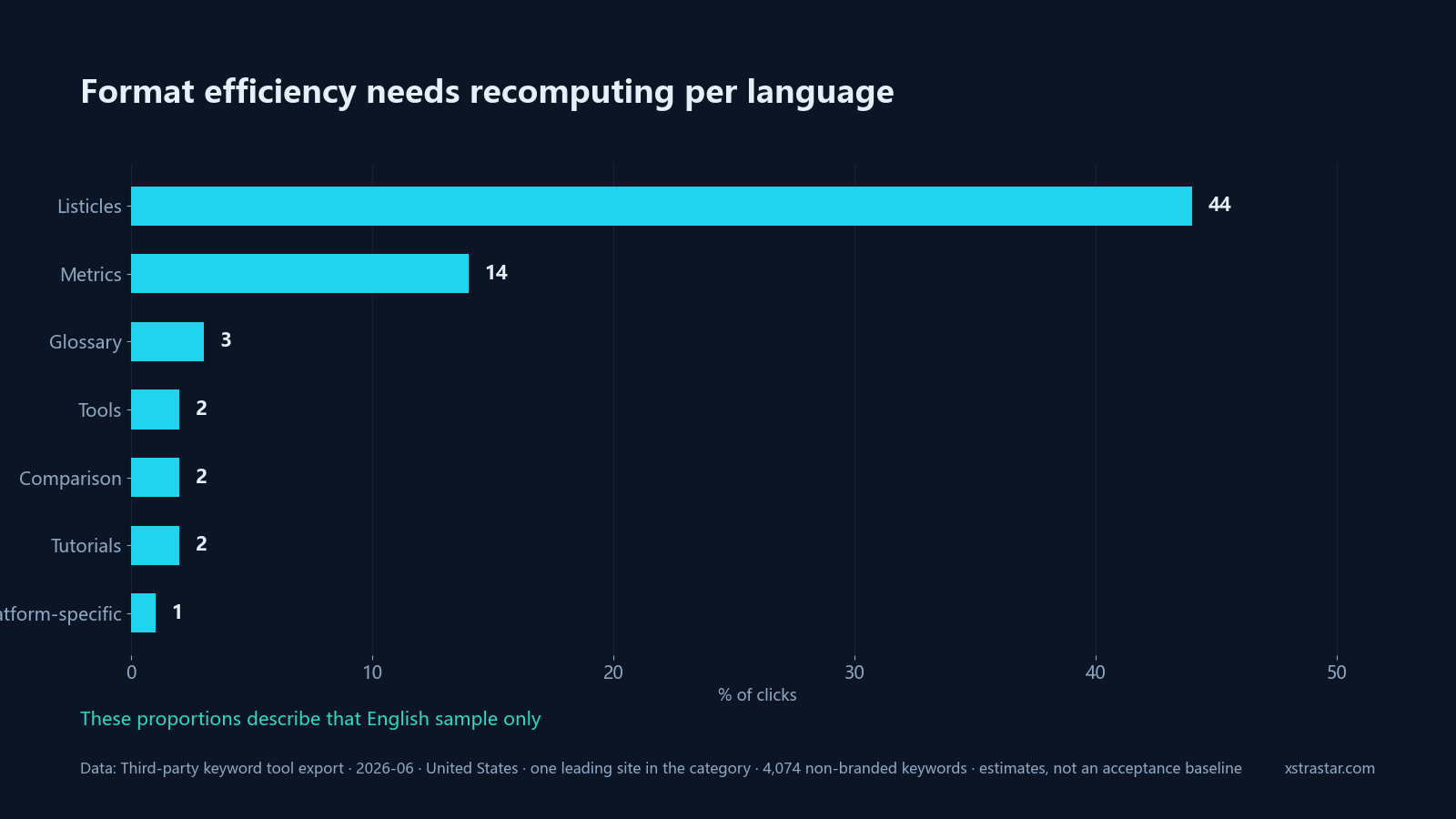
Key takeaway: Second-language visibility splits into translation, localisation (local phrasing, local examples, local units and regulatory wording) and independent sourcing (market-specific questions, most-cited source types, platform list). Translation alone produces readable pages that retrieval does not surface, because phrasing differs, source ecosystems differ, and format efficiency needs recomputing per language: a third-party export shows 44% of English-market category clicks in listicle formats, 14% in metrics and 3% in glossary, proportions that cannot be carried across languages. The question pool must be built independently in the first batch, since it supplies the mention-rate denominator and the content list. Three technical requirements: absolute internal URLs, a full structured-data and sitemap set per language with declared correspondence, and band distribution recorded per language. Scan by character set for language residue in labels, footers and table headers.
Related: Localisation is not translation | Chinese vs English sources | Cross-border SaaS visibility | Prompt set design
Sources: Format and click distribution from a third-party keyword tool export (2026-06, United States, one leading site in the category, 4,074 non-branded keywords); estimates describing that English sample only. Job split and technical requirements from XstraStar multilingual project practice.
Last updated: 2026-08-27
Turn insight into growth
Find your next AI search growth opportunity
From brand visibility and citation sources to content strategy, the XstraStar team will help you map a clear, measurable GEO optimization path.
Talk to a GEO advisorAbout the author
XstraStar Editorial Team
GEO Research & Strategy
The XstraStar editorial team studies AI search, generative engine optimization, and brand visibility, turning platform mechanics, field experience, and market shifts into practical growth guidance.
Related insights