Five Items A Usable Baseline Must Contain
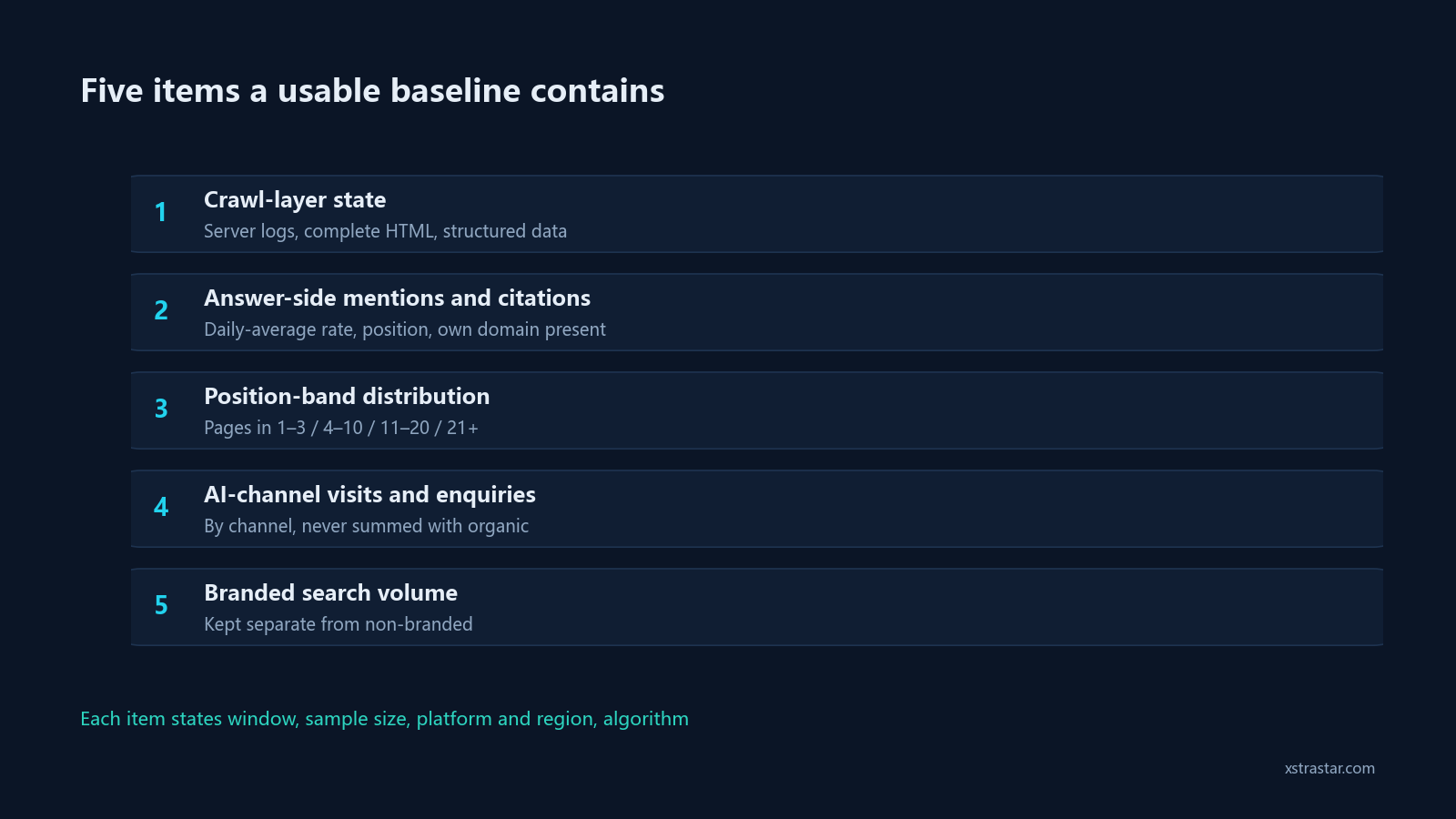
A usable baseline covers five items: crawl-layer state, answer-side mentions and citations, organic position-band distribution, AI-channel visits and enquiries, and branded search volume.

XstraStar Editorial Team
GEO Research & Strategy

In this article
A usable baseline covers five items: crawl-layer state, answer-side mentions and citations, organic position-band distribution, AI-channel visits and enquiries, and branded search volume. Drop one and a class of change becomes unexplainable at quarter-end.
A baseline exists so that "how much did it change" has an answer. Without one, quarter-end reporting falls back on absolute values, and absolute values carry no causation.
What each item records
| # | Item | What to record | Source |
|---|---|---|---|
| 1 | Crawl-layer state | Retrieval-crawler request counts and response statuses, whether the server returns complete HTML, whether structured data exists | Server logs plus fetch tests |
| 2 | Answer-side mentions and citations | Mention rate on a fixed question pool (daily average), average position when mentioned, whether the own domain appears in cited-domain lists | Own collection or a monitor, plus human verification |
| 3 | Position-band distribution | How many pages sit in 1–3 / 4–10 / 11–20 / 21+ for target keywords | Search console or third-party tools |
| 4 | AI-channel visits and enquiries | Sessions and enquiries from AI channels, split by channel | Site analytics, server logs, form records |
| 5 | Branded search volume | Branded search volume and clicks, separated from non-branded | Search console |
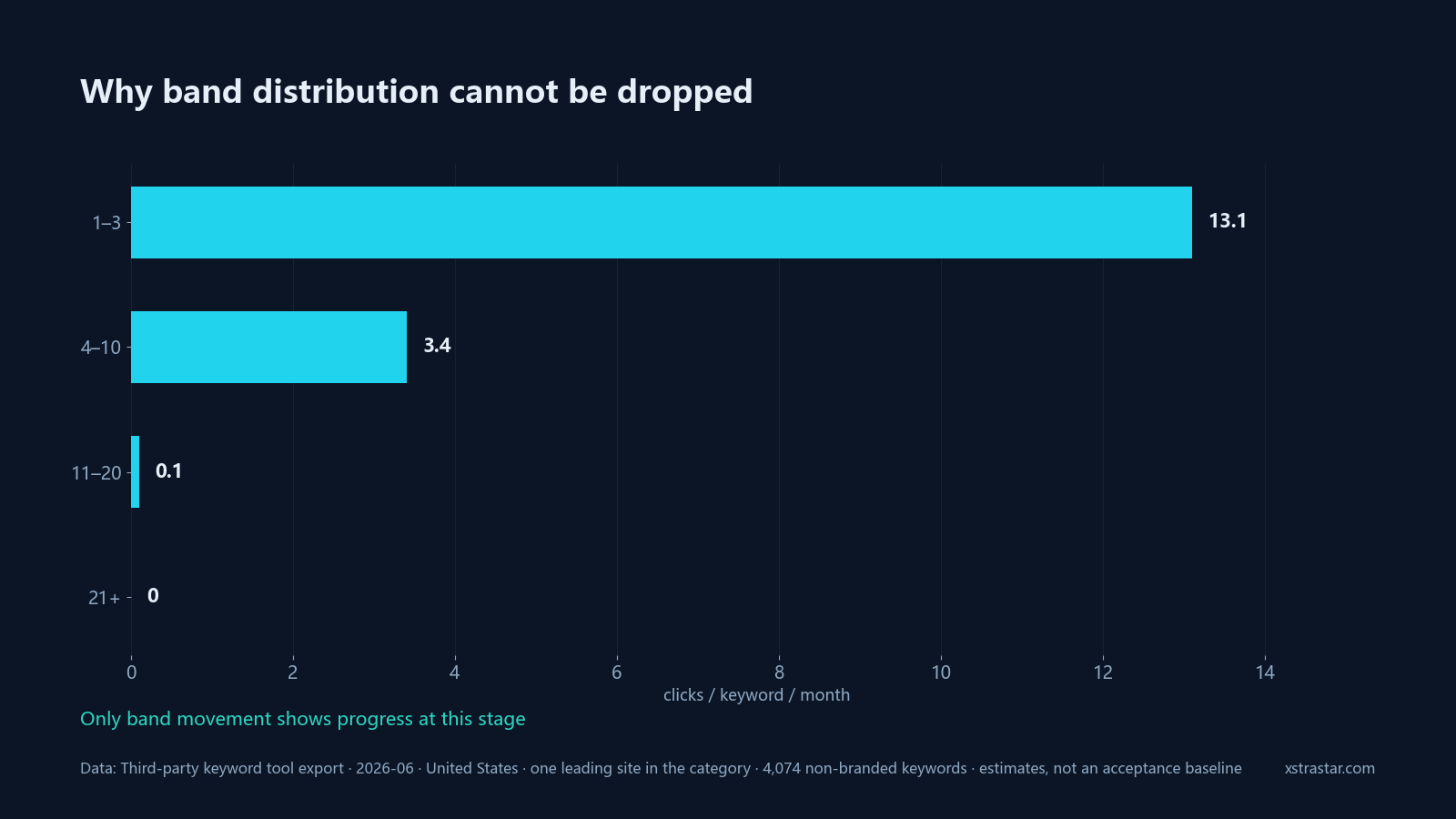
Why item 3 cannot be dropped
Organic clicks follow ranking. A third-party per-keyword export (2026-06, United States, one leading site in this category, 4,074 non-branded keywords) shows 13.1 monthly clicks per keyword at positions 1–3, 3.4 at 4–10, 0.1 at 11–20 and 0.0 beyond 21.
Without a starting band distribution, flat sessions at quarter-end cannot distinguish two situations: pages never moved, or pages climbed from beyond 21 to position 15, which is real progress invisible in clicks. Band distribution is the only metric that shows progress at that stage.
Every item carries its method
A baseline is a set of figures with methods attached. Each item states at least four things:
collection window (start and end dates)
sample size (questions × runs per question; or keywords, or pages)
platform and region
algorithm (denominator, de-duplication, treatment of gaps)
⚠️ A baseline without methods fails at the first comparison. The two most common failures: runs per question changed (one run first time, three the second, and the percentages stop being comparable) and the question pool changed (two periods with different questions cannot be compared).
Three traps
Recording an incomplete run as zero. A failed collection day is a gap. Counting it as zero drags the average to a fraction of the real value, so the baseline needs a separate column for valid collection days.
Using a cumulative basis. Cumulative coverage trends toward 100% as the window grows, so a cumulative baseline makes every later comparison show improvement. Use a daily average.
Measuring only the subject. With no comparison set, quarter-end cannot separate "this programme worked" from "the whole category rose". Include how comparable parties performed on the same question set, recorded as distribution and without naming them.
How long a baseline takes
About two weeks, in parallel with the foundations phase. Those two weeks produce three verifiable things: logs proving crawling works, five items archived with methods, and a page matrix yielding an output ceiling. Missing any one of them turns later judgement into a bet.
Key takeaway: A usable baseline covers five items: crawl-layer state (retrieval-crawler requests and statuses in server logs, complete HTML, structured data), answer-side mentions and citations (daily-average mention rate on a fixed pool, average position, own domain present in cited-domain lists or not), organic position-band distribution across 1–3 / 4–10 / 11–20 / 21+, AI-channel visits and enquiries split by channel, and branded search volume kept separate from non-branded. Band distribution is mandatory, because third-party data shows 0.1 monthly clicks per keyword at positions 11–20 and 0.0 beyond 21, leaving band movement as the only visible progress at that stage. Each item states collection window, sample size, platform and region, and algorithm. Three traps: recording failed collection days as zeros, using a cumulative basis, and measuring only the subject with no comparison set. Allow about two weeks, in parallel with foundations.
Related: Baseline before optimisation | Measurement discipline | AI visibility audit | First-party attribution | Branded search lift
Sources: Position bands and click distribution from a third-party keyword tool export (2026-06, United States, one leading site in the category, 4,074 non-branded keywords); estimates, not an acceptance baseline. The five-item list and method requirements from XstraStar delivery practice.
Last updated: 2026-08-27
Turn insight into growth
Find your next AI search growth opportunity
From brand visibility and citation sources to content strategy, the XstraStar team will help you map a clear, measurable GEO optimization path.
Talk to a GEO advisorAbout the author
XstraStar Editorial Team
GEO Research & Strategy
The XstraStar editorial team studies AI search, generative engine optimization, and brand visibility, turning platform mechanics, field experience, and market shifts into practical growth guidance.
Related insights


