Mention Rate Needs Two Companions
Mention rate alone carries three blind spots: a rise says nothing about whether the site got cited, nothing about position inside the answer, and nothing about visits.

XstraStar Editorial Team
GEO Research & Strategy

In this article
Mention rate alone carries three blind spots: a rise says nothing about whether the site got cited, nothing about position inside the answer, and nothing about visits. The two metrics that close the gap are share of citations and arrivals plus enquiries on the receiving end. Together the three form one chain.
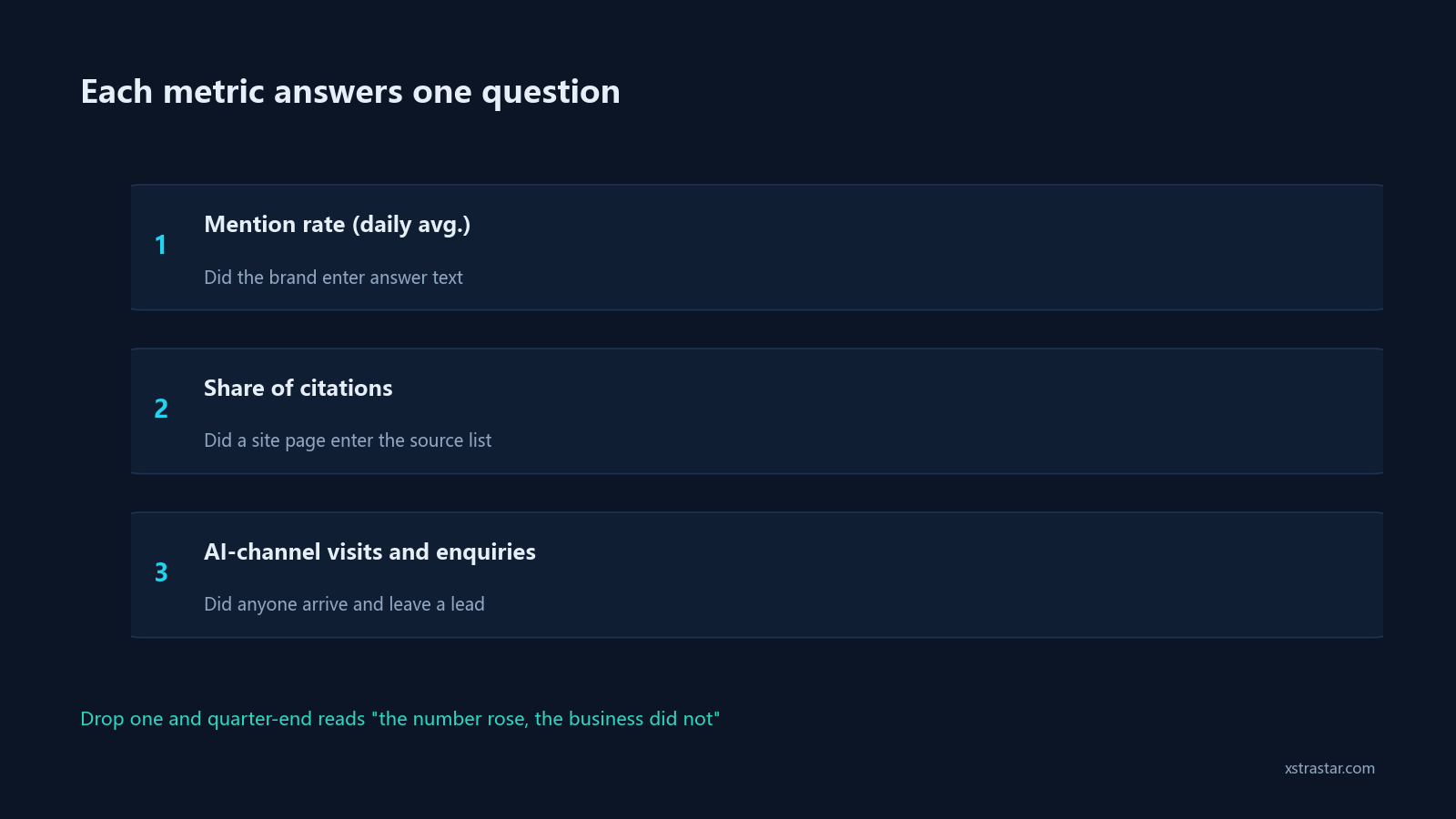
Each metric answers one question. Drop any of them and quarter-end produces "the number went up, the business did not".
What each answers
| Metric | Question answered | Blind spot alone |
|---|---|---|
| Mention rate (daily average) | Did the brand enter answer text | The citation may point at somebody else's page; the mention may sit in a bare list |
| Share of citations | Did a site page enter the answer's source list | Being cited is not being clicked; some platforms return no source URL |
| AI-channel visits and enquiries | Did anyone travel from the answer to the site and leave a lead | Volumes stay small and noisy, so the metric misleads on its own |
Why the single metric distorts
Blind spot 1: mentions and citations decouple. The answer names the brand and cites a third-party page. That visibility rests on another party's content, produces no clicks, and gets replaced by stronger evidence. Test: whether the own domain appears in the cited-domain list.
Blind spot 2: position information disappears. Mention rate is a presence check. Where the brand appears in the answer, and whether the appearance is a bare list entry or a recommendation, stay invisible. Record average position when mentioned and mention depth alongside it, and label the sample count whenever it runs low.
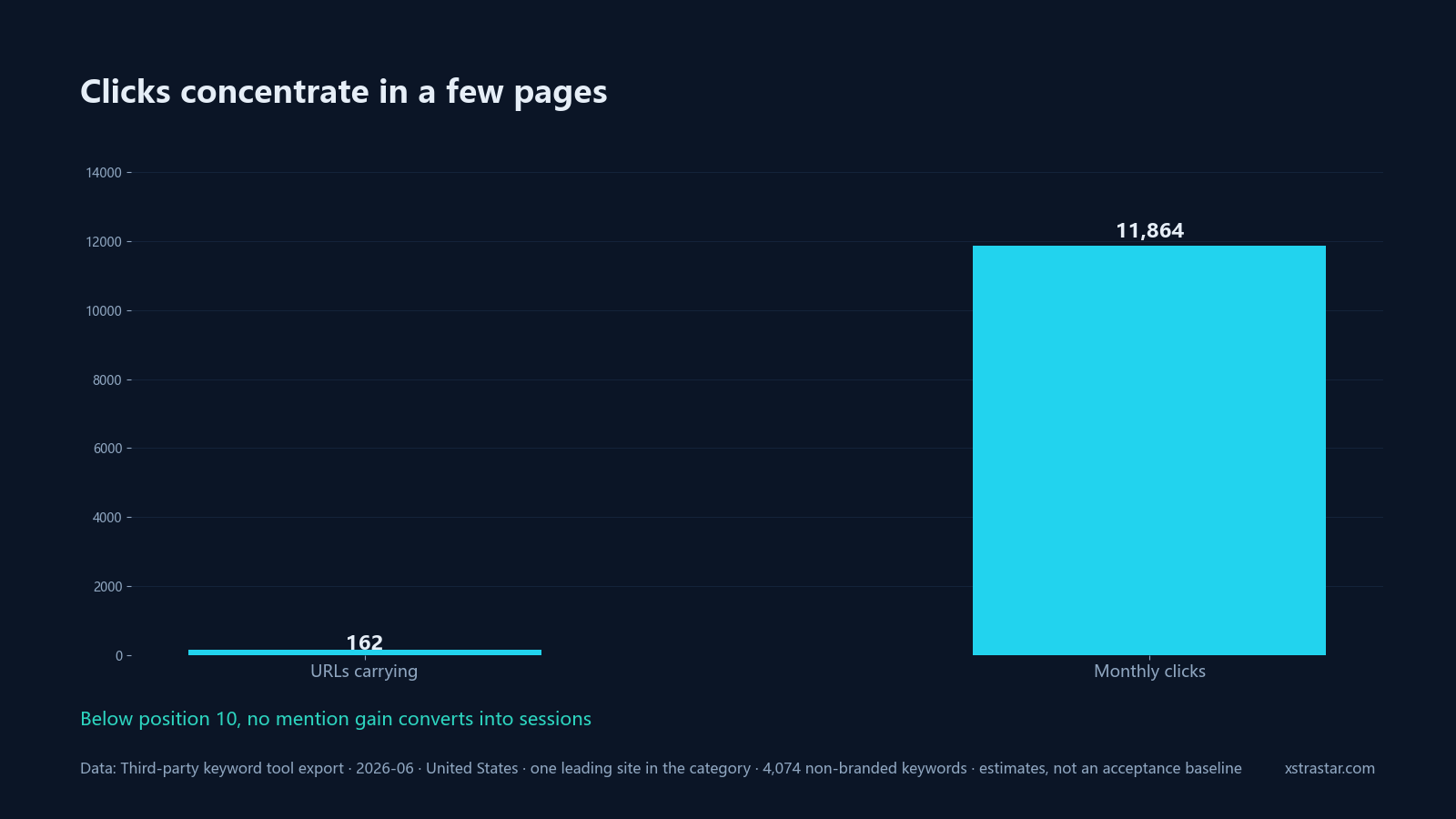
Blind spot 3: the link to traffic is indirect. Organic clicks still follow ranking. A third-party per-keyword export (2026-06, United States, one leading site in this category, 4,074 non-branded keywords, 11,864 monthly clicks) shows 13.1 monthly clicks per keyword at positions 1–3 and 0.1 at 11–20, with those 11,864 clicks carried by 162 URLs. A page below position 10 will not translate any mention-rate gain into sessions.
How the three combine by stage
| Stage | Primary | Supporting | Not yet |
|---|---|---|---|
| Validation / pilot | Mention rate (daily average) plus average position when mentioned | Share of citations, crawl-to-index chain | Traffic; volume has not arrived |
| Volume build | Position-band migration plus share of citations | Mention rate | Total session count |
| Steady state | AI-channel visits and enquiries plus organic traffic | Mention rate, share of citations | — |
⭐ Primary metrics differ by stage, and that belongs in the acceptance clause from day one. Otherwise every stage gets questioned against the previous stage's metric.
Four reporting rules
- Mention rate on a daily-average basis, never cumulative coverage.
- Report Chinese and English separately, never merged into one coverage figure. Answer mechanisms and source ecosystems differ enough that a merged number makes every change unattributable.
- Every figure carries its sample size: questions × runs per question. Average position with fewer than three samples always states the count.
- List AI-channel volume by channel, never added to organic search. ⚠️ Part of AI-driven arrival lands in "direct", so those two rows stay separate and stay unsummed.
⚠️ One more rule that gets skipped: platform-exported mention flags are unusable as delivered. Matchers have a history of false positives, and a column where every verdict is identical usually means the match never ran. Any externally used figure needs a human pass.
Key takeaway: Mention rate as a sole KPI carries three blind spots: the brand can enter answer text while a third-party page gets the citation (test: own domain present in the cited-domain list), the metric is a presence check that discards position and depth, and its link to traffic is indirect — third-party data shows 13.1 monthly clicks per keyword at positions 1–3 against 0.1 at 11–20, with 11,864 monthly clicks carried by 162 URLs, so a page below position 10 converts no mention gain into sessions. The two companions are share of citations and AI-channel visits plus enquiries. Primary metrics differ by stage (validation: mention rate and average position; volume build: band migration and share of citations; steady state: visits, enquiries and organic traffic) and belong in the acceptance clause. Four reporting rules: daily-average basis, languages reported separately, sample size on every figure, AI channels listed separately and never summed with organic search. Platform-exported mention flags require human verification.
Related: Mention rate | Citation rate | AI referral traffic | Average position | Measurement discipline
Sources: Position bands, click distribution and carrying URL count from a third-party keyword tool export (2026-06, United States, one leading site in the category, 4,074 non-branded keywords); estimates, not an acceptance baseline. Metric pairing and reporting rules from XstraStar monitoring practice.
Last updated: 2026-08-27
Turn insight into growth
Find your next AI search growth opportunity
From brand visibility and citation sources to content strategy, the XstraStar team will help you map a clear, measurable GEO optimization path.
Talk to a GEO advisorAbout the author
XstraStar Editorial Team
GEO Research & Strategy
The XstraStar editorial team studies AI search, generative engine optimization, and brand visibility, turning platform mechanics, field experience, and market shifts into practical growth guidance.
Related insights