Competitor Rankings Do Not Measure Market Demand
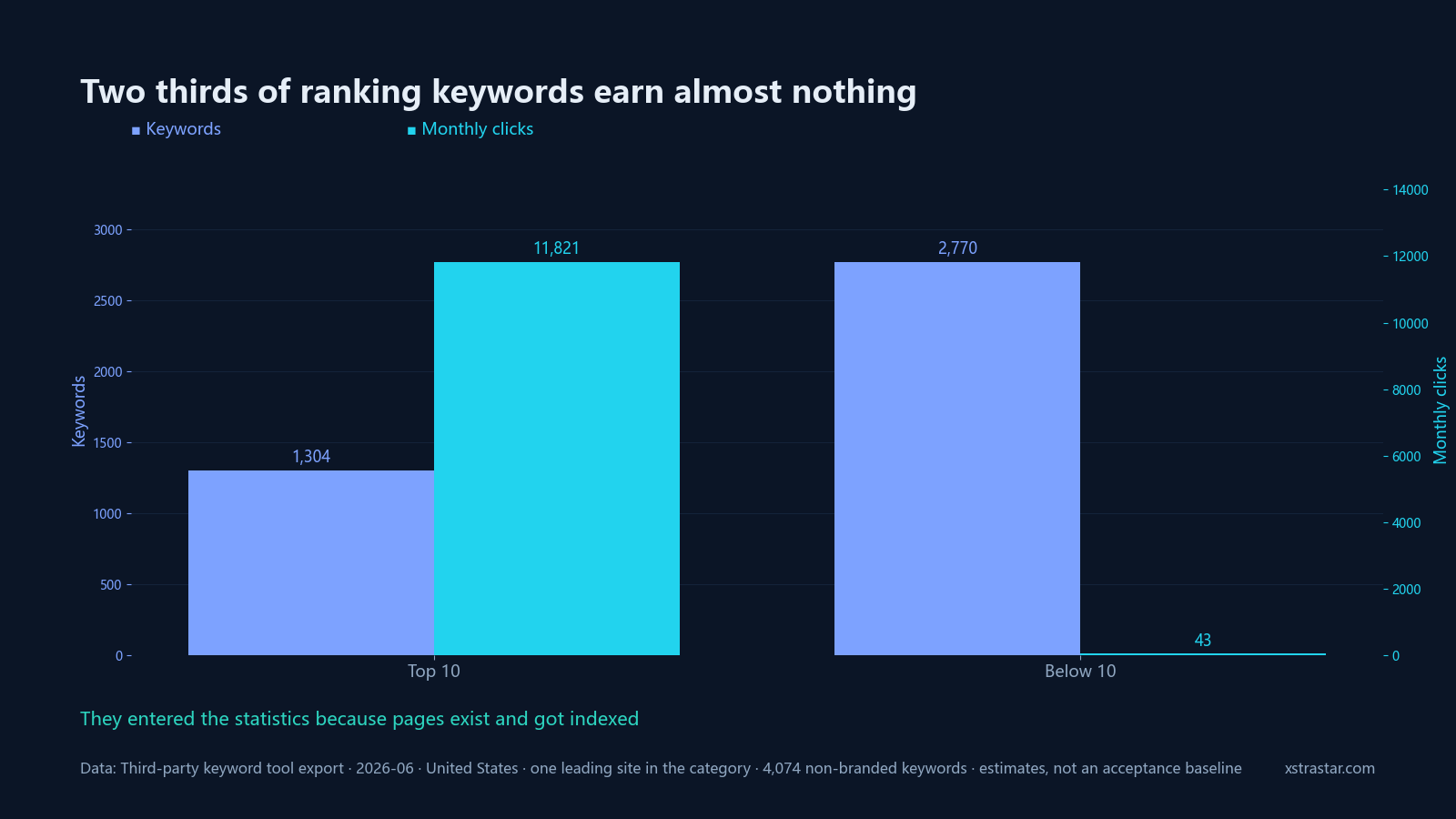
In one per-keyword study, a leading site held rankings for 4,074 non-branded keywords, and 2,770 of them (68%) sat below position 10, producing 43 clicks combined.

XstraStar Editorial Team
GEO Research & Strategy

In this article
In one per-keyword study, a leading site held rankings for 4,074 non-branded keywords, and 2,770 of them (68%) sat below position 10, producing 43 clicks combined. Treating "a competitor ranks for these keywords" as evidence of demand mistakes one site's indexing breadth for market demand.
Demand needs evidence from the demand side. Competitor rankings answer a different question: whether anyone has worked this direction, and how far they got.
What the data actually says
Third-party keyword tool export, 2026-06, United States, one leading site in this category, 4,074 non-branded keywords, 11,864 organic clicks per month.
| Position band | Keywords | Combined monthly clicks |
|---|---|---|
| Top 10 | ~1,300 | ~11,800 |
| Below position 10 | 2,770 | 43 |
Two thirds of that site's ranking keywords contribute almost nothing to its own traffic. They entered the statistics because pages exist and got indexed, which carries no necessary relationship to how many people search.
What competitor rankings can and cannot answer
| Can answer | Cannot answer |
|---|---|
| Somebody has worked this direction | How many people search for it |
| Which band they reached | How much of that search carries commercial intent |
| Which page type they used | Whether the same page could reach the top 10 here |
| Roughly where difficulty sits | Whether the direction is worth the work |
⚠️ A frequent misuse: "the competitor has zero coverage here, so there is no demand". Zero coverage equally means nobody has built it yet, which is the definition of an open slot. Platform-specific keywords are the example: 307 keywords, 52,920 monthly searches, 141 clicks collected.
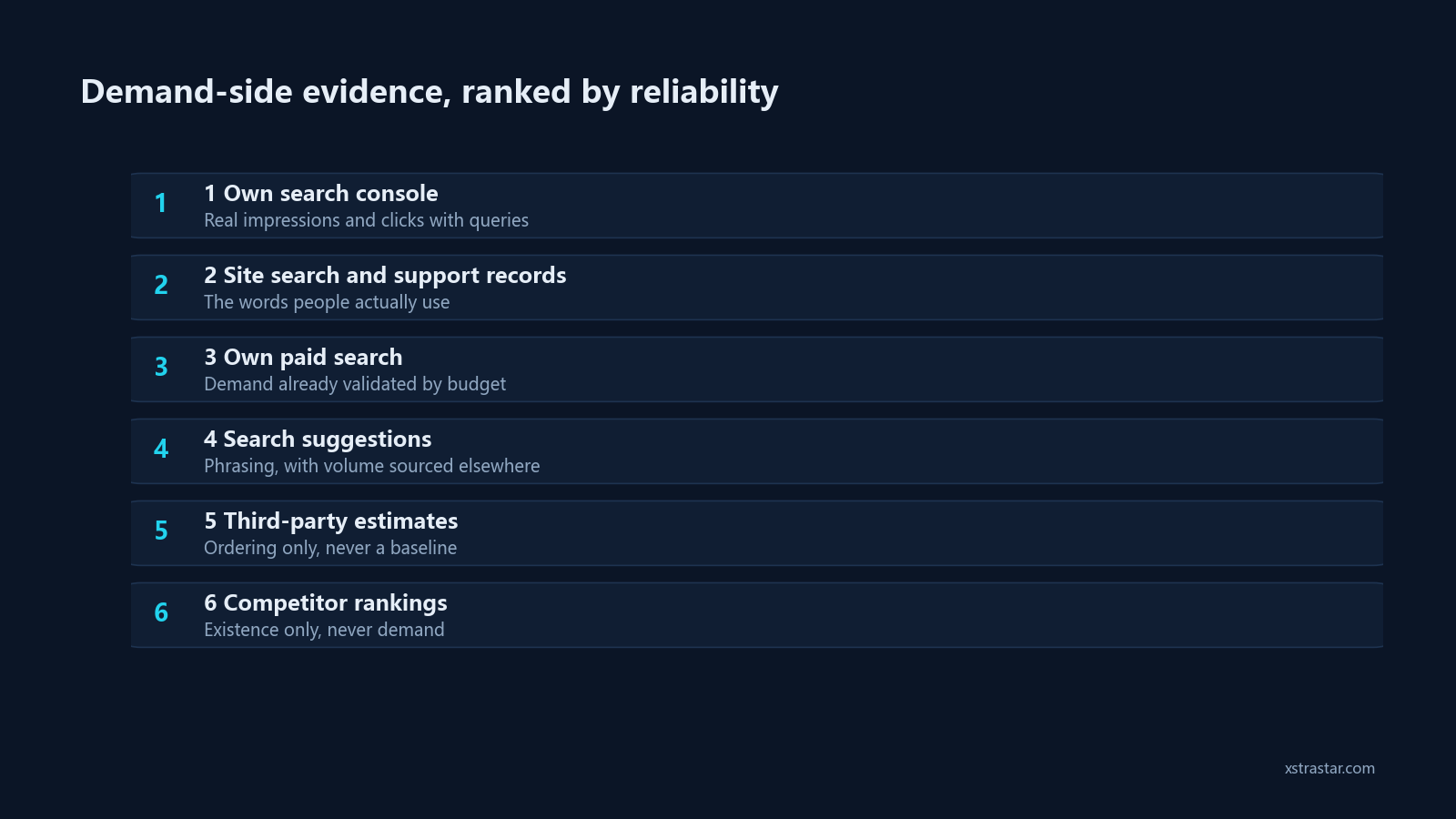
Demand-side evidence, ranked by reliability
- Own search console data: real impressions and clicks with query terms. The only first-party demand evidence available.
- Own site search and support records: the words people use to describe the problem.
- Own paid search data: where keywords were bought, their volume and conversion have already been validated by budget.
- Search suggestions and related searches: good for phrasing, with volume sourced elsewhere.
- Third-party volume estimates: usable for ordering and magnitude, not as an acceptance baseline, and not comparable across tools.
- Competitor rankings: usable for whether anyone has built it and how far they got, never for whether demand exists.
A workable split
Separate "worth doing" from "can a number be attached" into two columns:
| Direction | Worth doing (intent and business relevance) | Number attachable (demand-side evidence) |
|---|---|---|
| A | Yes, decision-stage question | Yes, impressions already in the console |
| B | Yes, decision-stage question | No, third-party estimate only → build it, attach no target figure |
| C | No, unrelated to the business | Volume exists → skip |
⭐ Row B is the one handled wrong most often: thin demand evidence permits building, and forbids writing a specific figure into a proposal or an acceptance clause. Filling a target from a third-party estimate writes the estimate's error into the contract.
Key takeaway: Competitor keyword rankings do not measure market demand. A 2026-06 third-party per-keyword export (United States, one leading site in the category) shows 2,770 of 4,074 non-branded ranking keywords (68%) below position 10, contributing 43 clicks combined, which means two thirds of that site's ranking keywords add almost nothing to its own traffic and entered the statistics only because pages exist and got indexed. Competitor rankings answer whether anyone has built a direction, which band they reached, which page type they used and roughly where difficulty sits; they cannot answer search volume, commercial intent, or whether a new page could reach the top 10. Zero competitor coverage may simply mean an unbuilt slot. Demand-side evidence ranks: own search console, own site search and support records, own paid search data, search suggestions, third-party estimates (ordering only), competitor rankings (existence only). Thin demand evidence permits building and forbids attaching a target figure.
Related: Competitive benchmarking | Position bands decide priority | Long tail before head terms | Baseline before optimisation
Sources: Keyword counts, position bands and click distribution from a third-party keyword tool export (2026-06, United States, one leading site in the category, 4,074 non-branded keywords); estimates, not an acceptance baseline. Top-10 keyword and click figures derived by subtracting the below-10 segment from the totals, and rounded.
Last updated: 2026-08-27
Turn insight into growth
Find your next AI search growth opportunity
From brand visibility and citation sources to content strategy, the XstraStar team will help you map a clear, measurable GEO optimization path.
Talk to a GEO advisorAbout the author
XstraStar Editorial Team
GEO Research & Strategy
The XstraStar editorial team studies AI search, generative engine optimization, and brand visibility, turning platform mechanics, field experience, and market shifts into practical growth guidance.
Related insights