Judging A Vendor Listicle: Four Things A Reader Can Check
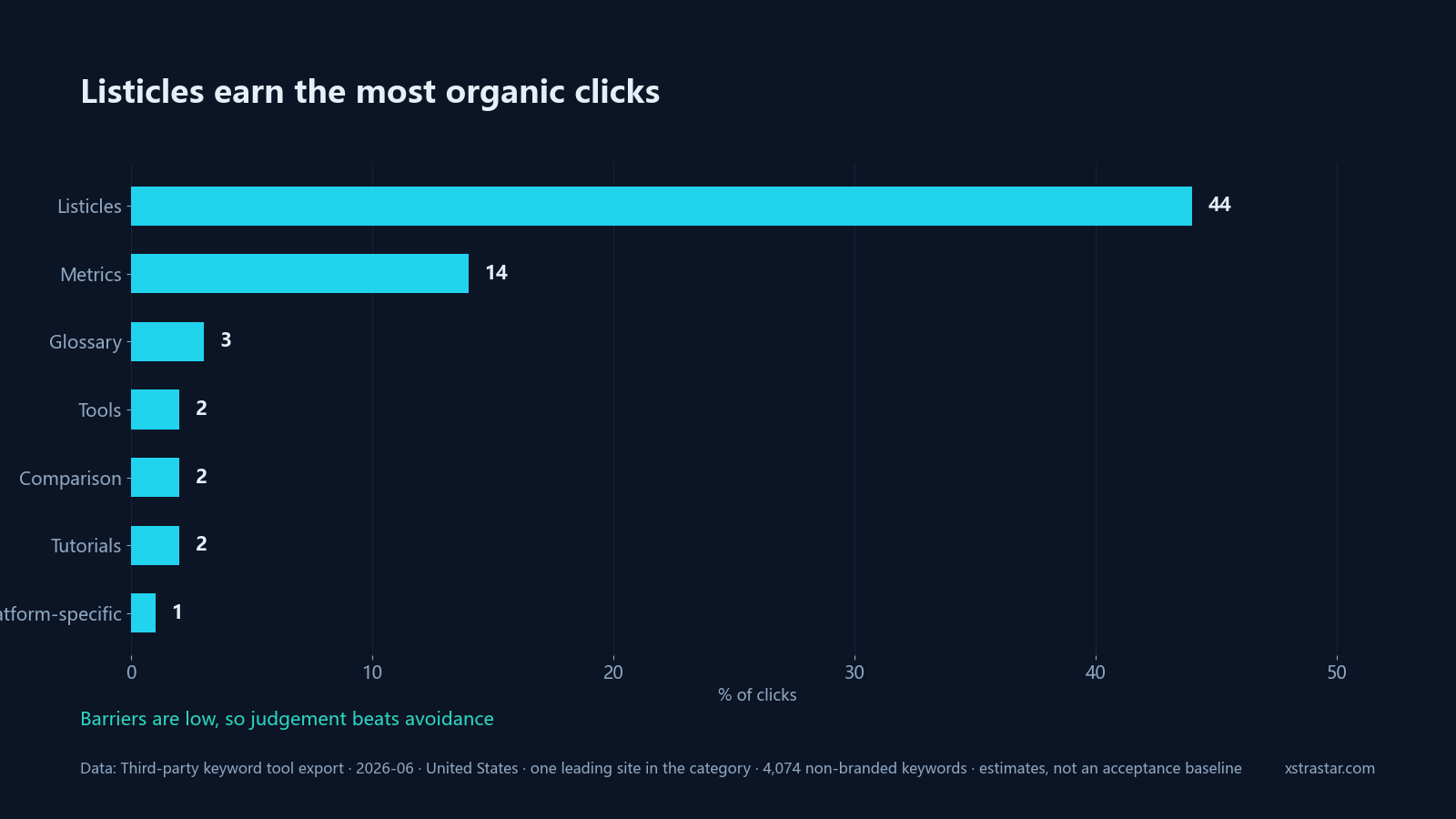
Listicle formats collect the most organic clicks in this category (44% of non-branded clicks) and rank among the formats generated answers cite most often.

XstraStar Editorial Team
GEO Research & Strategy

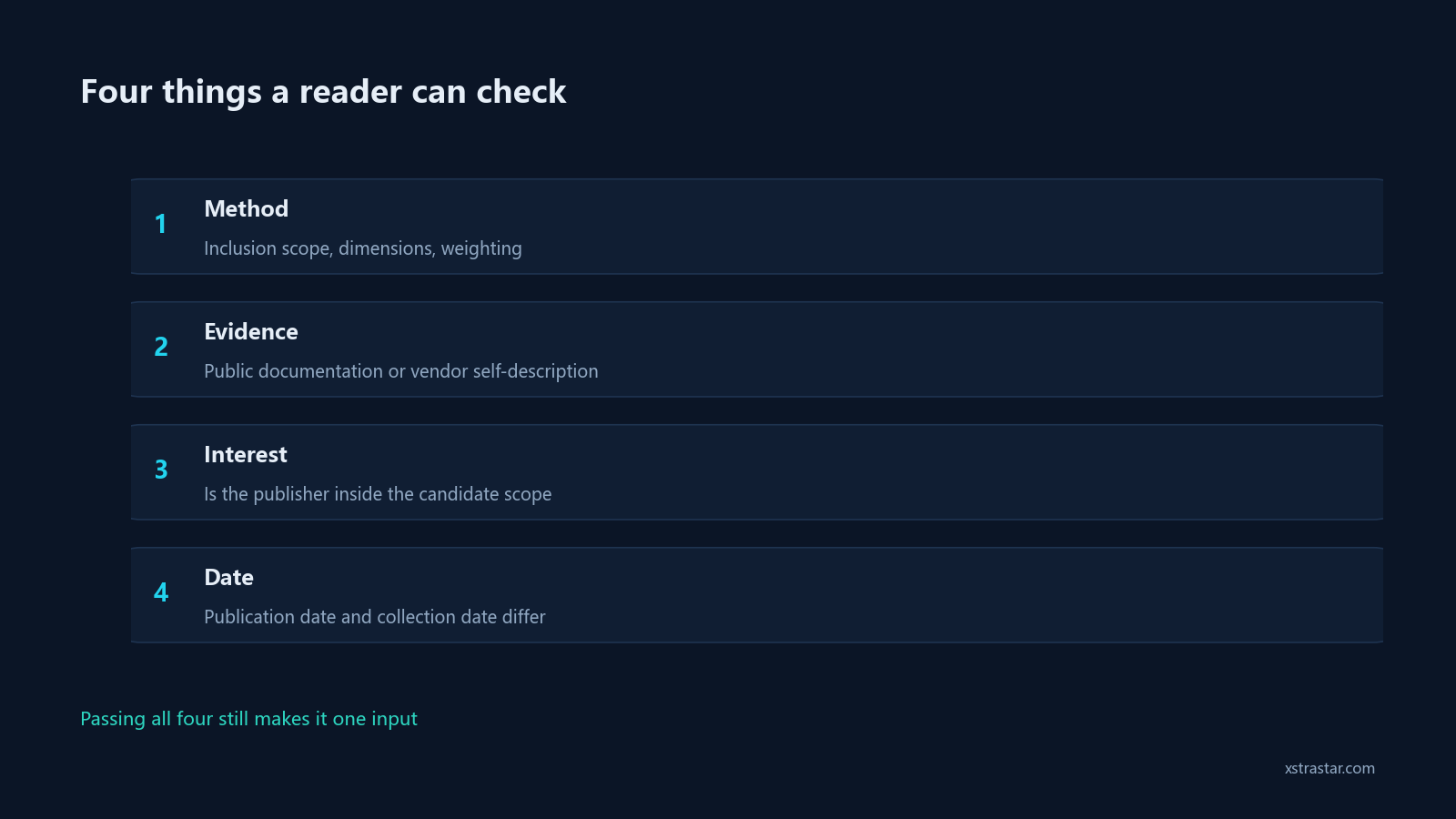
Listicle formats collect the most organic clicks in this category (44% of non-branded clicks) and rank among the formats generated answers cite most often. Barriers to publishing one are very low, so credibility comes down to four things any reader can verify: method, evidence, interest, and date.
None of these evaluates any particular listicle. The four form a general self-check.
Why listicles matter
Third-party keyword tool export, 2026-06, United States, one leading site in this category, 4,074 non-branded keywords, 11,864 organic clicks per month.
| Format | Keywords | Monthly searches | Monthly clicks | Share |
|---|---|---|---|---|
| Listicles / selection | 1,060 | 195,150 | 5,213 | 44% |
| Metrics / measurement | 265 | 47,530 | 1,639 | 14% |
| All other formats combined | ~800 | ~134,000 | ~1,100 | ~10% |
Buyers read listicles while choosing, and models cite them while generating. Judgement therefore beats avoidance.
1. Method
A listicle should state three things: inclusion scope (who was considered, who was excluded), evaluation dimensions, and the weighting or the source of each criterion.
How to check: find the section describing how the scoring worked. Conclusions with no method describe an editor's preference and not a reproducible result.
2. Evidence
What the judgements rest on: public documentation, hands-on use, third-party data, or each vendor's own description.
How to check: pick one entry's justification at random and see what it cites. Citing a vendor's own marketing treats a claim as a fact. Citing public documentation, published pricing, or a reproducible test result is a different level of reliability.
3. Interest
The easiest item to check, and the least often checked.
How to check: look at who published it. Where the publisher falls inside the listicle's own candidate scope, the third-party quality of the piece does not hold regardless of the position assigned. Also look for paid inclusion, sponsored slots, and how partner links are labelled.
⚠️ A vendor publishing its own ranking on its own site carries a second problem: in Chinese-language contexts, such statements count as unprovable ranking claims and fall under advertising law.
4. Date
How to check: locate the publication date and the data collection date, which are two different dates. Product capability and platform policy move quickly in this category, so capability descriptions older than about six months are usually stale. ⚠️ A listicle with a publication date and no collection date offers no way to judge currency.
The four-step pass
| Step | What to find | Conclusion when absent |
|---|---|---|
| 1 | The section on how scoring worked | Conclusions without method: read as editorial preference |
| 2 | What the justifications cite | All vendor self-description: read as marketing material |
| 3 | Publisher's relation to the candidate scope | Publisher inside scope: third-party quality does not hold |
| 4 | Data collection date | Missing: currency cannot be judged |
⭐ A listicle that passes all four remains one input. In a selection decision, place it beside two other kinds of evidence: public facts verifiable directly (documentation, published pricing, supported platform lists), and results measured on the buyer's own question pool.
⚠️ A note for content teams: precisely because the barrier is low and the influence high, this format belongs on third-party sites only. When publisher and candidate are the same party, step 3 fails by construction.
Key takeaway: Listicle formats collect the most organic clicks in this category (third-party data: 1,060 keywords, 195,150 monthly searches, 5,213 monthly clicks, 44% of non-branded clicks) and get cited often by generated answers, while barriers to publishing remain very low. Readers can check four things: method (inclusion scope, dimensions, weighting or criterion sources; absent means editorial preference), evidence (public documentation and reproducible tests against vendor self-description), interest (whether the publisher sits inside the candidate scope, plus paid inclusion and sponsored slots; a vendor ranking itself on its own site also falls under advertising-law constraints in Chinese contexts), and date (publication and collection dates differ, and a missing collection date makes currency unjudgeable). A listicle passing all four is still one input, to be read beside directly verifiable public facts and results measured on the buyer's own question pool. For content teams, this format belongs on third-party sites only.
Related: Vendor claims vs evidence | GEO market reality | GEO myths | Page type matrix
Sources: Keyword counts, search volume and click distribution from a third-party keyword tool export (2026-06, United States, one leading site in the category, 4,074 non-branded keywords); estimates, not an acceptance baseline. The combined "all other formats" row is an approximate sum of the remaining rows. The four checks derive from XstraStar external-content standards and vendor-material review practice.
Last updated: 2026-08-27
Turn insight into growth
Find your next AI search growth opportunity
From brand visibility and citation sources to content strategy, the XstraStar team will help you map a clear, measurable GEO optimization path.
Talk to a GEO advisorAbout the author
XstraStar Editorial Team
GEO Research & Strategy
The XstraStar editorial team studies AI search, generative engine optimization, and brand visibility, turning platform mechanics, field experience, and market shifts into practical growth guidance.
Related insights


