How Long GEO Takes: Three Phases And Their Acceptance Tests
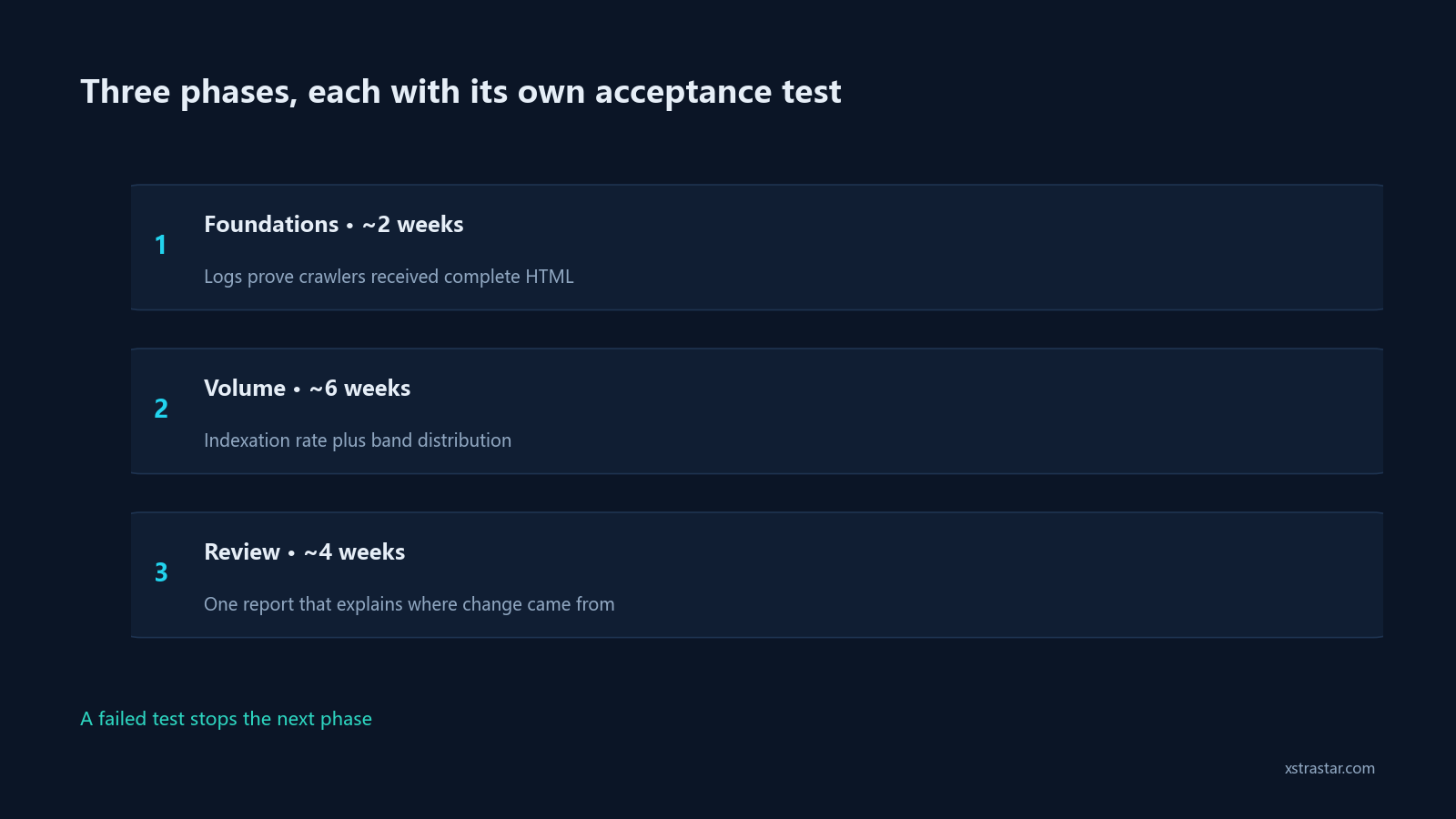
A quarter divides into roughly three phases: foundations for about two weeks, volume for about six, review and adjustment for about four.

XstraStar Editorial Team
GEO Research & Strategy

In this article
A quarter divides into roughly three phases: foundations for about two weeks, volume for about six, review and adjustment for about four. Each phase carries its own deliverables and acceptance test, and a failed test stops the next phase. Publishing volume before the foundations close produces dirty feedback data, which invalidates every judgement built on it.
"How long until results" has no single-number answer. What can be answered: what should be visible at the end of each phase, and which phase sits outside the supplier's control.
Deliverables and tests
| Phase | Length | Deliverables | Acceptance test |
|---|---|---|---|
| Foundations | ~2 weeks | Crawl-layer audit and fixes; question pool finalised with a measured baseline; page matrix and output ceiling | All three present, with server logs proving retrieval crawlers received complete HTML |
| Volume | ~6 weeks | Glossary and structural pages first (low unit cost, enumerable), plus a batch of opinionated deep pages as template validation; section routing, internal-link matrix and structured data in place; off-site and entity signals in parallel | Indexation rate, and the position-band distribution of the first batch |
| Review | ~4 weeks | Band migration; cut directions still beyond position 30 at high difficulty; promote page types stuck at 11–20 | One complete report: mention rate split by language, band distribution, AI-channel visits and enquiries, branded search volume change |
Why phase one cannot be compressed
Those two weeks produce three verifiable results: logs proving crawling works, a baseline archived with its method, and a page matrix that yields an output ceiling. Missing any one of them turns the following six weeks into a bet.
The usual shortcut is "start writing and fix the technical issues along the way". Its cost arrives six weeks later, when the ranking and citation data cannot be attributed, because nobody knows how much of it came from the crawl layer.
Why phase two involves waiting
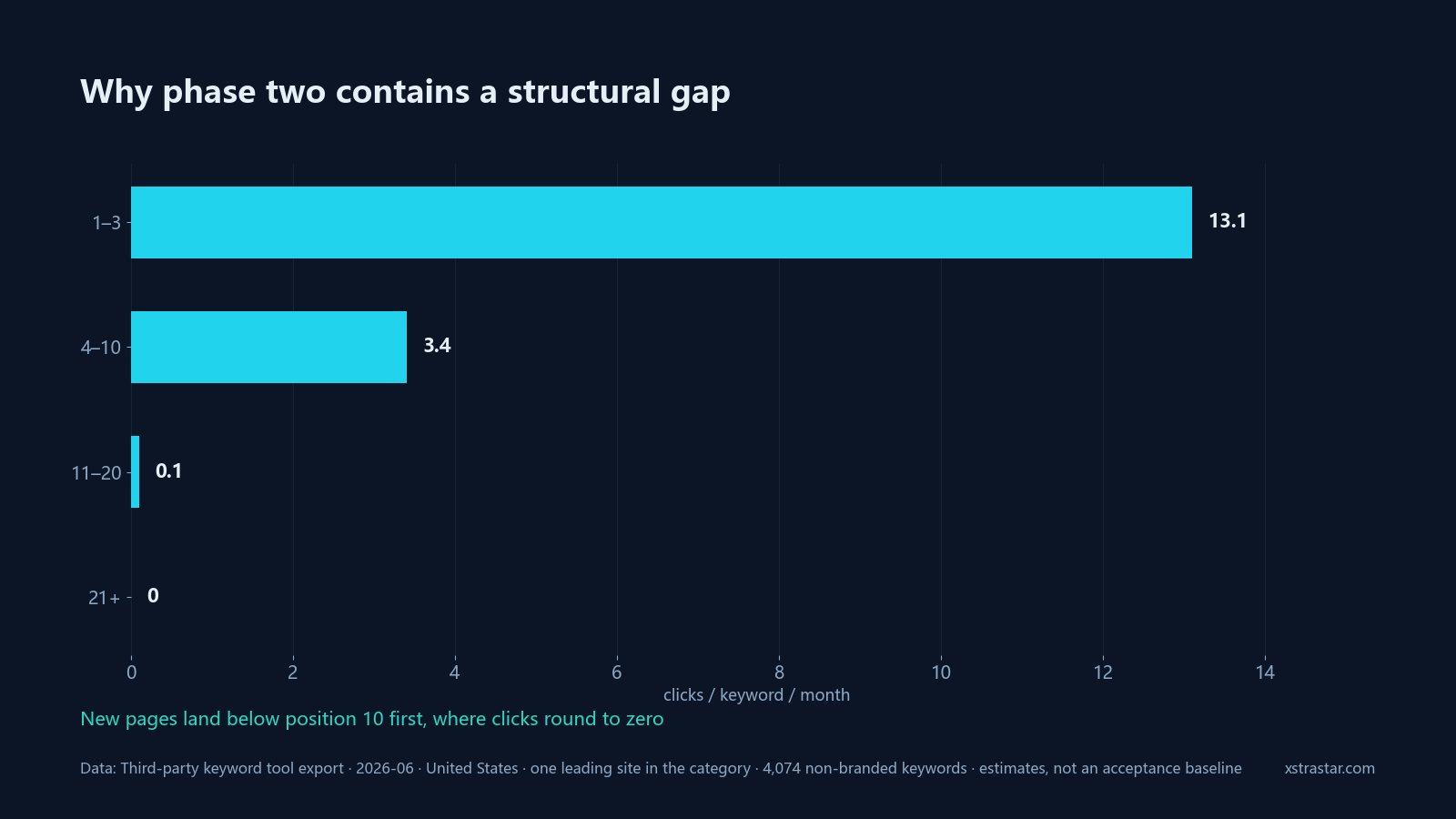
Organic clicks follow ranking. A third-party per-keyword export (2026-06, United States, one leading site in this category, 4,074 non-branded keywords) shows 13.1 monthly clicks per keyword at positions 1–3, 3.4 at 4–10, 0.1 at 11–20 and 0.0 beyond 21.
New pages usually land below position 10 first, inside the band where clicks round to zero. A gap between publication and top-10 entry is structural, and during that gap page counts rise while sessions do not. The acceptance test therefore reads band distribution, never session count.
The phase nobody on the supplier side controls
Indexation. Once pages are written, structured and linked, whether and when they get indexed depends on search and retrieval crawl cadence. Conditions can be created (crawlers allowed, server-side rendering, sitemaps submitted, internal links pointing in), and a date cannot be promised.
That is why the phase-two test names two observable quantities, indexation rate and band distribution, instead of a delivery date.
Commitment tiers
| Stage | Committable | Not committable |
|---|---|---|
| Validation / pilot | Mention gains and average-position improvement on a fixed question pool; a working crawl-to-index chain; a report that explains the changes | Ranking positions, and traffic |
| Full engagement | Measurable organic growth, and improvement in AI recommendation position | Client-side sales and conversion, unless data and method are shared |
⚠️ Committing to traffic before the validation stage usually fails, because crawl-layer state, whether content can reach the top 10, and whether off-site work moves the needle are all unknown until measured. Turning those three unknowns into knowns is what the validation stage is for.
Key takeaway: A GEO quarter runs in three phases: foundations (~2 weeks; test: server logs prove retrieval crawlers received complete HTML, with a method-labelled baseline and a page matrix in hand), volume (~6 weeks; test: indexation rate plus position-band distribution of the first batch), and review (~4 weeks; test: a complete report covering mention rate by language, band distribution, AI-channel visits and enquiries, and branded search change). Phase two contains a structural gap, because new pages land below position 10 where third-party data shows 0.1 monthly clicks per keyword, so progress is read from band distribution and not from sessions. Indexation cadence is outside supplier control: conditions can be created, dates cannot be promised. Validation commits to mention gains and a working measurement chain; organic growth belongs to the full engagement.
Related: First 90 days | Commitment tiers | Baseline before optimisation | Staged publishing | Quarterly review loop
Sources: Position bands and click distribution from a third-party keyword tool export (2026-06, United States, one leading site in the category, 4,074 non-branded keywords); estimates, not an acceptance baseline. Phase structure and tests from XstraStar delivery practice.
Last updated: 2026-08-27
Turn insight into growth
Find your next AI search growth opportunity
From brand visibility and citation sources to content strategy, the XstraStar team will help you map a clear, measurable GEO optimization path.
Talk to a GEO advisorAbout the author
XstraStar Editorial Team
GEO Research & Strategy
The XstraStar editorial team studies AI search, generative engine optimization, and brand visibility, turning platform mechanics, field experience, and market shifts into practical growth guidance.
Related insights


