When A Platform Returns No Source URLs
Some AI platforms return only a source title, a publisher name and a snippet, with no URL. Source-frequency and title-format statistics still work on that side. Page-level attribution does not.

XstraStar Editorial Team
GEO Research & Strategy

In this article
Some AI platforms return only a source title, a publisher name and a snippet, with no URL. Source-frequency and title-format statistics still work on that side. Page-level attribution does not. Merging both kinds of sample into one percentage produces a figure that looks more complete and is less trustworthy.
Three steps handle it: label the gap, switch to evidence that side can carry, and keep platforms in separate columns.
What is actually missing
| Available | Missing |
|---|---|
| Publisher name | Which specific page |
| Title and snippet | Whether that page still exists for verification |
| Frequency of appearance | Whether several domain forms point to one article |
| Title format (listicle, review, guide) | Publication and update dates |
The second row is the one that matters: no URL means no return to the original. Any claim about which sentence an answer drew from is unavailable on that side.
Which metrics take the hit
| Metric | Impact | Handling |
|---|---|---|
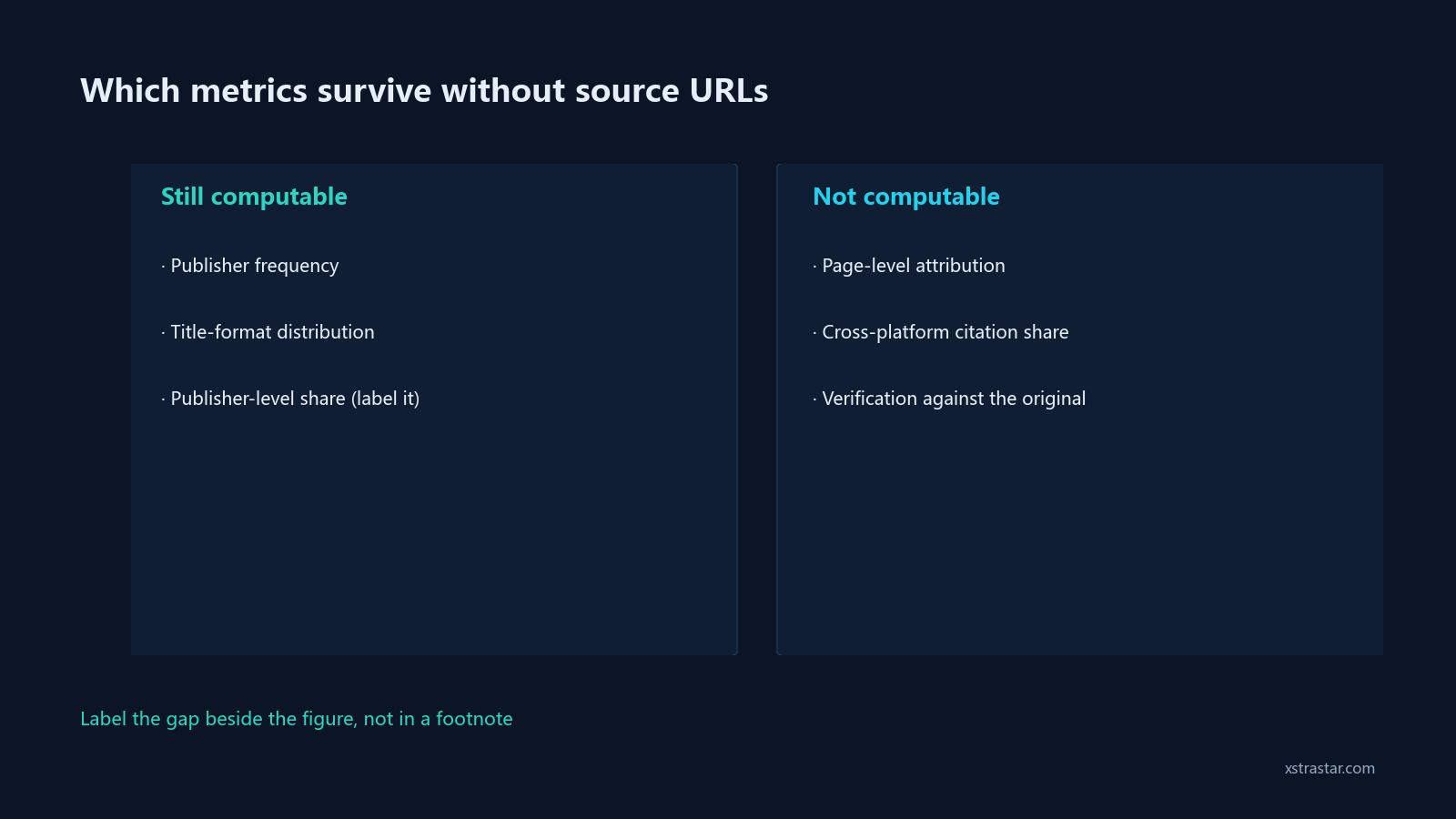
| Publisher frequency | None | Report normally |
| Title-format distribution | None | Report normally |
| Share of citations by domain | Partial | Count by publisher name and label it "by publisher, not de-duplicated by domain" |
| Page-level citation attribution | Unavailable | State "this platform returns no URL; metric missing" |
| Cross-platform share of citations | Not computable | Do not produce the combined figure |
The three steps
Step 1: put the gap beside the number, not in a footnote. Add a column for URL availability with three values: all, partial, none. Availability is a property of the data, so it belongs on the same row as the figure it qualifies.
Step 2: switch to evidence that side can carry.
- Store the original link, title, publisher and publication date at collection time. When the platform withholds the URL, search the publisher's site by title during collection and keep the result, so later verification rests on internal records.
- Answer publisher-level questions instead of page-level ones. That side can say which publishers get cited; it cannot say which article does.
- Treat server logs as the evidence layer for crawling. Retrieval crawlers that execute no JavaScript never appear in front-end analytics, and logs see them.
Step 3: separate columns, no merging. Report by platform, each column carrying its own method line. Across platforms, present directional agreement only, never a single merged percentage.
A check available today
Pull the source records from the most recent collection window and compute the share that carry a URL. Below 100%, every citation-share figure in the report needs a method label. Where a platform sits at 0%, that platform is blind for page-level attribution, and the statement belongs on the report's first page.
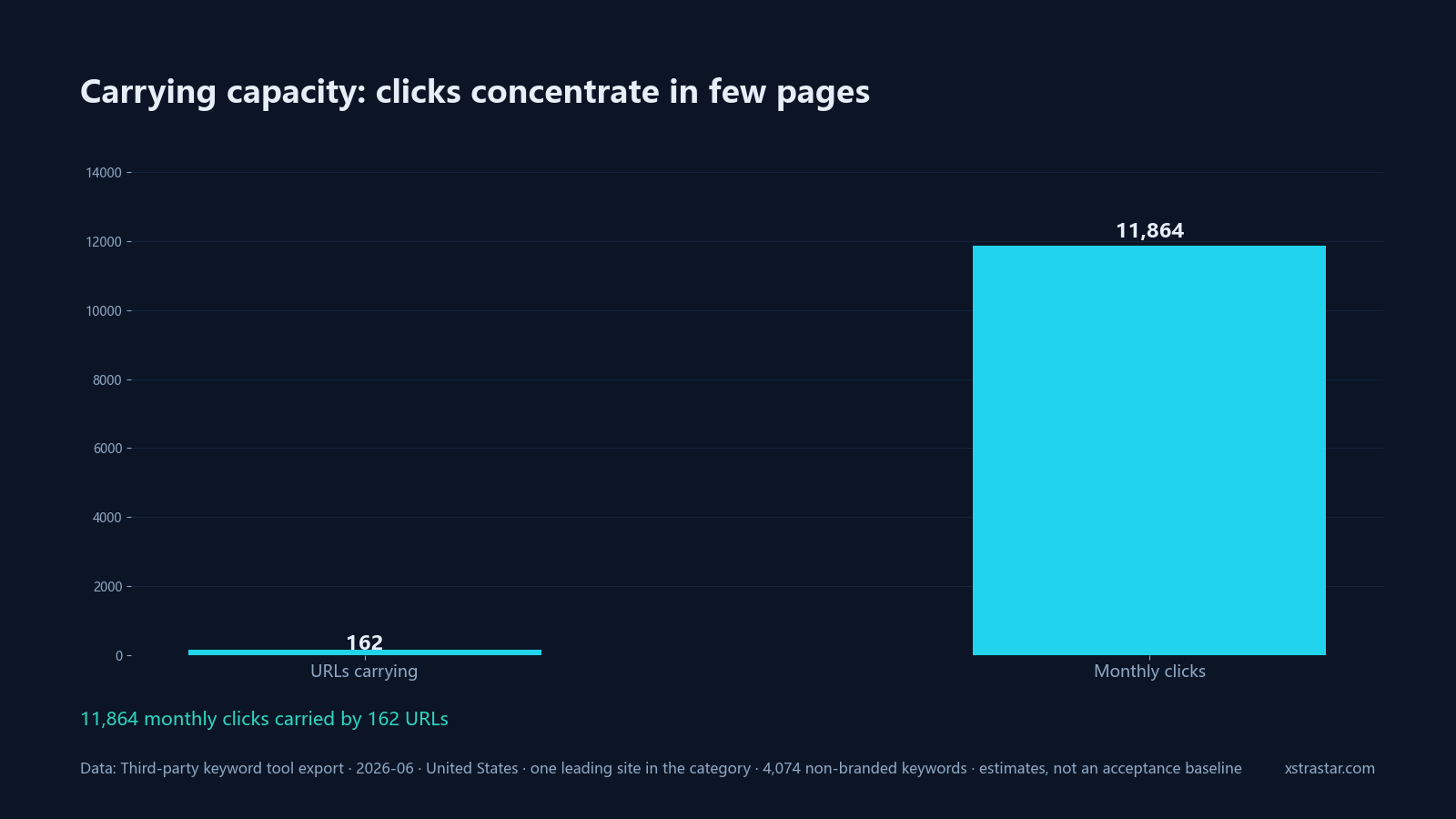
⚠️ A related confusion worth closing: citation and ranking are two mechanisms. Ranking can be estimated with third-party tools (one 2026-06 per-keyword export showed 11,864 monthly organic clicks in this category carried by 162 URLs). Citation can only be collected from the answer side. Neither evidence chain substitutes for the other.
Key takeaway: Some AI platforms return source titles, publisher names and snippets without URLs. Publisher frequency and title-format distribution remain reportable on that side, page-level citation attribution becomes unavailable, and cross-platform citation share stops being computable. Handling takes three steps: carry a URL-availability column next to the figures instead of a footnote; capture the original link, title, publisher and date at collection time, shift to publisher-level conclusions, and use server logs as crawl-side evidence; report platforms in separate columns with their own method lines and present only directional agreement across platforms. The check is the share of sources carrying a URL in the current window; below 100%, every citation-share figure needs a method label.
Related: Cited source mix | Crawl log analysis | Verify crawling with logs | First-party first
Sources: Handling method from XstraStar monitoring practice. The carrying-capacity figure (11,864 monthly clicks across 162 URLs) from a third-party keyword tool export (2026-06, United States, one leading site in the category, 4,074 non-branded keywords); estimate.
Last updated: 2026-08-27
Turn insight into growth
Find your next AI search growth opportunity
From brand visibility and citation sources to content strategy, the XstraStar team will help you map a clear, measurable GEO optimization path.
Talk to a GEO advisorAbout the author
XstraStar Editorial Team
GEO Research & Strategy
The XstraStar editorial team studies AI search, generative engine optimization, and brand visibility, turning platform mechanics, field experience, and market shifts into practical growth guidance.
Related insights