Tutorials Earn Little Traffic. Three Reasons To Write Them Anyway
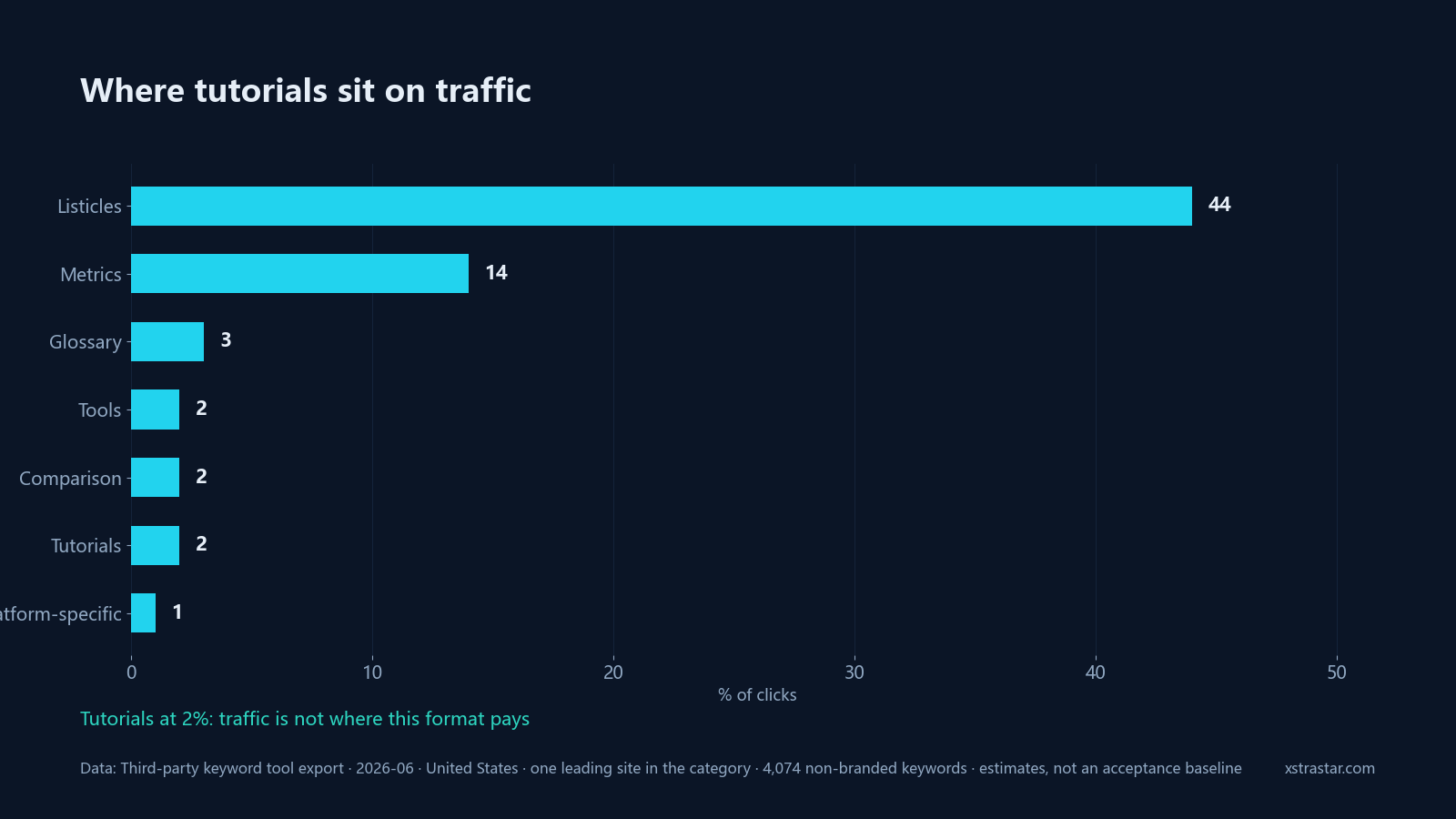
Tutorial keywords in this per-keyword study number 126 and collect 190 monthly clicks, 2% of non-branded clicks. Ranked by traffic, the format sits near the bottom.

XstraStar Editorial Team
GEO Research & Strategy

In this article
Tutorial keywords in this per-keyword study number 126 and collect 190 monthly clicks, 2% of non-branded clicks. Ranked by traffic, the format sits near the bottom. Three other properties justify it: ordered steps are among the easiest content for an answer to lift whole, the format turns internal process into a reusable asset, and it decides whether a reader can act afterwards.
Scheduling tutorials by traffic produces a decision to skip them. Scheduling by citation and conversion reverses it.
Where the traffic sits
Third-party keyword tool export, 2026-06, United States, one leading site in this category, 4,074 non-branded keywords.
| Format | Keywords | Monthly searches | Monthly clicks | Share |
|---|---|---|---|---|
| Listicles / selection | 1,060 | 195,150 | 5,213 | 44% |
| Metrics / measurement | 265 | 47,530 | 1,639 | 14% |
| Glossary / definitions | 120 | 23,870 | 384 | 3% |
| Tutorials | 126 | 14,920 | 190 | 2% |
Search volume (14,920) sits low in the table and clicks follow. Traffic is not where this format pays.
The three reasons
Structure built for extraction. A tutorial is ordered steps, each with an input, an action and a result. That is precisely the shape an answer can carry away intact. Opinion pieces require the reader to distil a point, which lowers extraction odds.
Internal process becomes an asset. A clearly written tutorial fixes a procedure that otherwise lives in conversation. The internal value often exceeds the external one: new team members follow it, delivery accepts against it, clients reconcile against it. The same document serves as internal procedure and external content, and the cost is paid once.
It decides whether the reader can act. Someone finishing an opinion piece agrees with a judgement. Someone finishing a tutorial performs a task. Anyone who has performed the task once arrives at a very different conversation afterwards. Conversion value shows up in that next step, never in time on page.
Which tutorials deserve the slot
| Worth writing | Not worth writing |
|---|---|
| Steps with verifiable intermediate results (what the log should show, which status code returns) | A generic process restatement with no checkpoints |
| Explicit failure modes and where to look | Happy path only |
| One specific judgement (how to confirm a crawler received complete content) | One broad concept (how to do content well) |
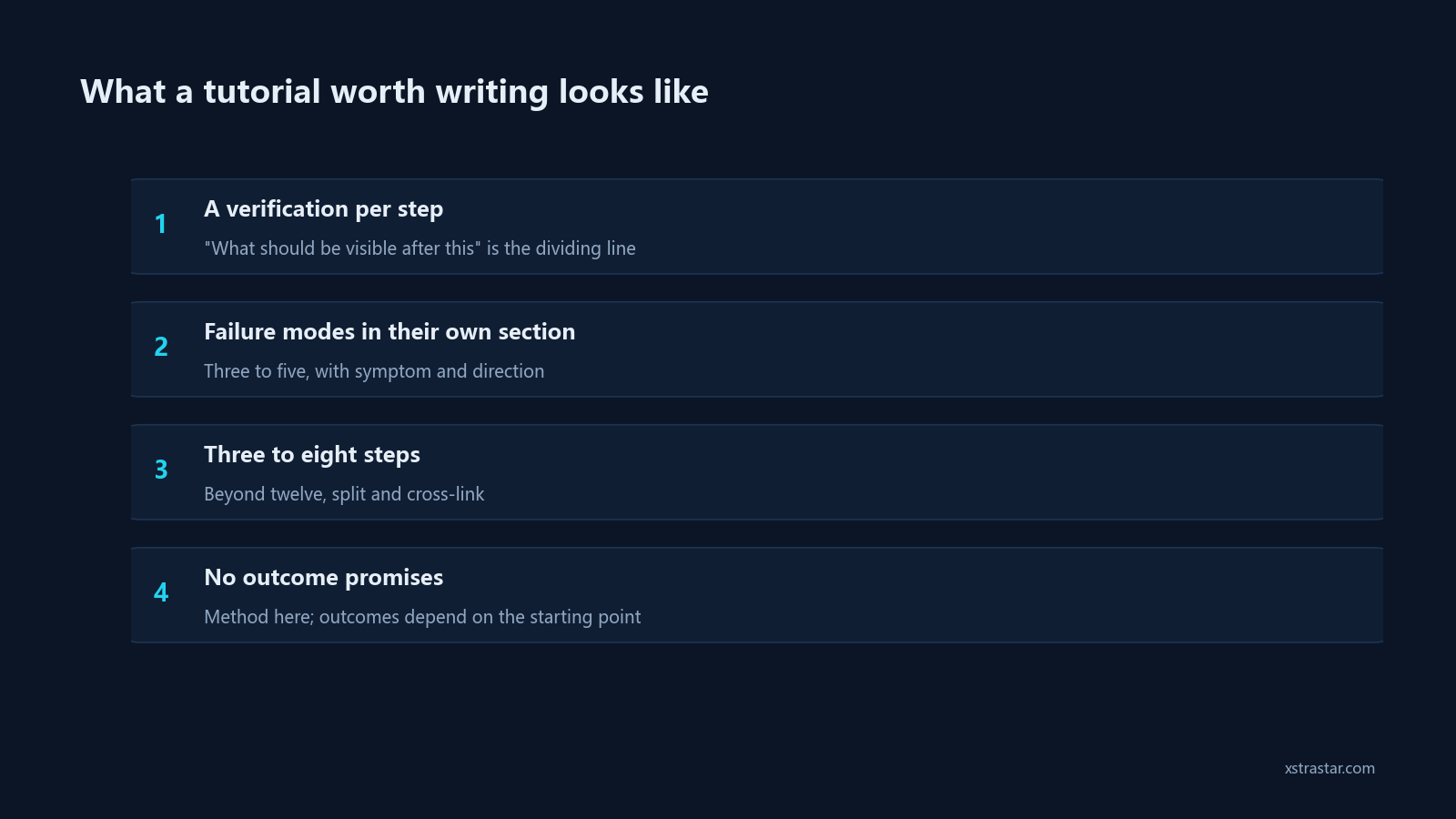
| Three to eight steps | More than twelve steps (split into several linked pieces) |
Three writing requirements
- State the verification for every step. "What should be visible after this change" is the line between a tutorial and a process restatement. Without it, a reader who finishes has no way to know whether it worked.
- Give failure modes their own section. Three to five common failures, each with symptom and direction. This section attracts the most citation, because the person asking is usually stuck on a failure.
- Keep outcome promises out. A tutorial covers method; outcomes depend on starting point and execution. Mixing the two lowers the credibility of both.
⚠️ Scheduling position: tutorials belong in the "write when capacity allows" tier, and they should not be shelved permanently over low traffic. Their cost amortises against delivery-process documentation, which puts real unit cost below the apparent one.
Key takeaway: Tutorials hold a small traffic share in this category. A 2026-06 third-party per-keyword export (United States, one leading site in the category, 4,074 non-branded keywords) shows 126 tutorial keywords, 14,920 monthly searches and 190 monthly clicks, 2% of non-branded clicks. Three properties justify writing them: ordered steps extract cleanly into generated answers, one document serves as both internal procedure and external content, and readers who finish can act, with conversion value appearing in that next step instead of in time on page. Three requirements: state a verification for every step, give failure modes their own section, and keep outcome promises out. Tutorials belong in the capacity-permitting tier and should not be shelved permanently over low traffic.
Related: Quotable-first writing | Passage-first structure | Verify crawling with logs | Page type matrix
Sources: Keyword counts, search volume and click distribution from a third-party keyword tool export (2026-06, United States, one leading site in the category, 4,074 non-branded keywords); estimates, not an acceptance baseline. Writing requirements from XstraStar content delivery practice.
Last updated: 2026-08-27
Turn insight into growth
Find your next AI search growth opportunity
From brand visibility and citation sources to content strategy, the XstraStar team will help you map a clear, measurable GEO optimization path.
Talk to a GEO advisorAbout the author
XstraStar Editorial Team
GEO Research & Strategy
The XstraStar editorial team studies AI search, generative engine optimization, and brand visibility, turning platform mechanics, field experience, and market shifts into practical growth guidance.
Related insights