Comparison Pages: Taking A Position Without Taking A Risk
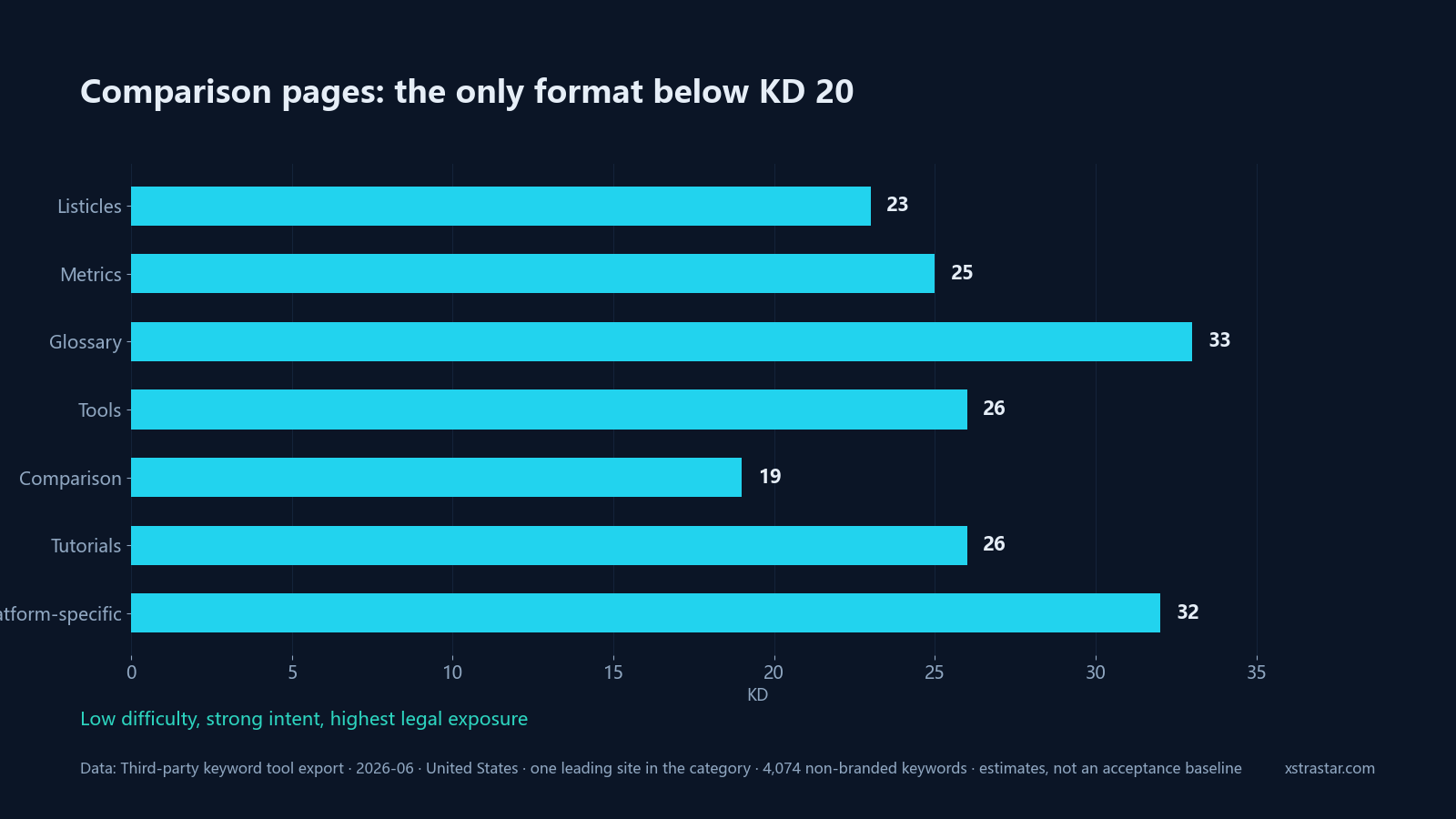
Comparison keywords carry the lowest difficulty in this per-keyword study (average 19, the only format below 20) and the intent closest to a decision.

XstraStar Editorial Team
GEO Research & Strategy

In this article
Comparison keywords carry the lowest difficulty in this per-keyword study (average 19, the only format below 20) and the intent closest to a decision. They also carry the highest legal exposure of any page type. One approach works: compare verifiable facts and let the reader draw the conclusion.
Why the format earns a slot
Third-party keyword tool export, 2026-06, United States, one leading site in this category, 4,074 non-branded keywords.
| Format | Keywords | Avg. difficulty | Monthly clicks |
|---|---|---|---|
| Comparison | 80 | 19 | 200 |
| Listicles / selection | 1,060 | 23 | 5,213 |
| Metrics / measurement | 265 | 25 | 1,639 |
| Glossary / definitions | 120 | 33 | 384 |
Difficulty 19 is the lowest in the table. Click volume stays modest at 200 per month, and the people behind those queries are already weighing options, so purchase intent runs well above other formats.
Four things safe to compare
| Category | Approach | Example shape |
|---|---|---|
| Concepts | Differences between two methods, two metrics, two technical routes | What GEO acts on against what SEO acts on; denominators behind mention rate and share of citations |
| Published facts | Capabilities stated in public documentation, tiers on public pricing pages, published platform support | Whether each platform returns source URLs |
| Method definitions | The same metric under different calculation rules | Coverage computed daily-average against cumulative |
| Fit by situation | Which route suits which conditions | Approach with an owned site against a marketplace storefront only |
Three things to leave out
Unprovable rankings and superlatives. "Industry-leading", "best results", "the only one able to" stay out, whether pointed at the publisher or at anybody else. Chinese-language pages carry explicit wording constraints on this, which makes it a hard rule and not a style preference.
Judgements about a third party's business condition or rumours about it. Who is cutting staff, who struggles to raise money, who lost accounts: publication risk lands on the publisher and any benefit lands on the competitor.
Another party's claims treated as facts. Self-descriptions on a competitor site, press paraphrase and sales talk are not verified facts. Compare only rows where both sides have public documentation, and leave the rest blank, marked as undisclosed.
A reusable page skeleton
- One-sentence conclusion up front: the core difference. Skip "which is better" and write "which conditions favour which".
- A comparison table: two columns, one verifiable dimension per row, source cited per row. Missing data reads "not disclosed"; never blank, never guessed.
- Where each side fits better: two paragraphs, each with a real situation. Both sides need a genuine one.
- Method and date: when the information was collected and where it came from. This page type ages fastest.
- A quotable conclusion block that lifts out whole, with its conditions attached.
Pre-publication checks
- Every table row carries a source, and every source opens
- No superlatives or absolute claims anywhere in the page
- No judgements about a third party's business condition
- Undisclosed cells labelled honestly, never filled with estimates
- The conclusion states conditions of fit, never which side is better
- Collection date printed on the page
- Chinese-language versions pass the advertising-law check
⚠️ The check most often skipped: comparison pages expire. One documentation update turns a row false. This page type belongs on a recurring review list, aligned with product release cadence, typically once a quarter.
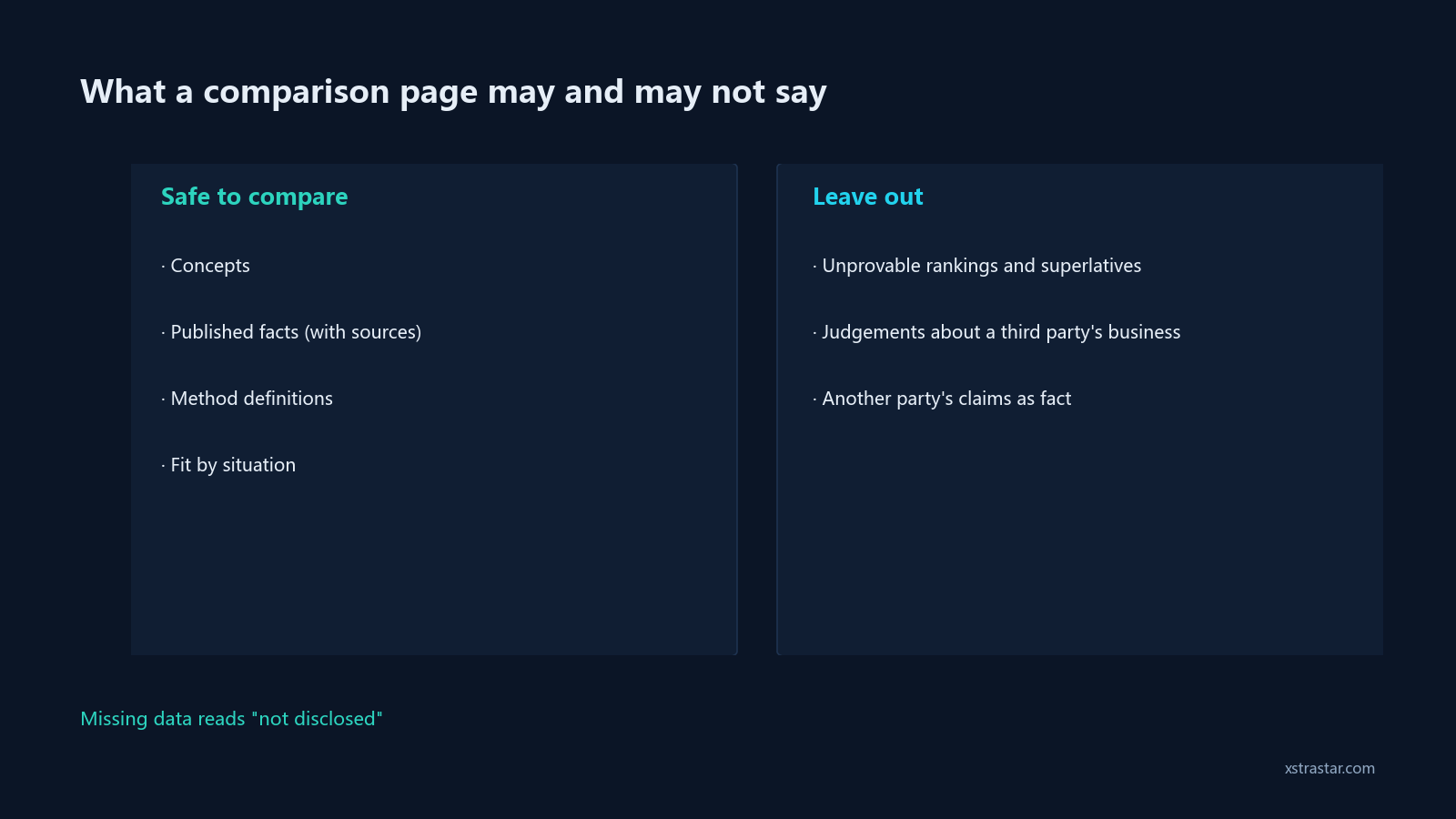
Key takeaway: Comparison pages carry the lowest difficulty in this category (third-party data: average 19, the only format below 20) and the strongest decision intent, alongside the highest legal exposure. Four safe comparison categories: concepts, published facts, method definitions, and fit by situation. Three to leave out: unprovable rankings and superlatives, judgements about a third party's business condition, and another party's claims treated as fact. The reusable skeleton is a conclusion stating conditions of fit, a source-cited comparison table with undisclosed cells labelled, situations favouring each side, collection method and date, and a quotable conclusion block. These pages expire when public documentation changes, so they belong on a quarterly review list.
Related: GEO vs SEO | Mention rate vs share of citations | Vendor claims vs evidence | Page type matrix
Sources: Difficulty and click distribution from a third-party keyword tool export (2026-06, United States, one leading site in the category, 4,074 non-branded keywords); estimates. Writing constraints and the checklist from XstraStar external-content standards and advertising-law checks.
Last updated: 2026-08-27
Turn insight into growth
Find your next AI search growth opportunity
From brand visibility and citation sources to content strategy, the XstraStar team will help you map a clear, measurable GEO optimization path.
Talk to a GEO advisorAbout the author
XstraStar Editorial Team
GEO Research & Strategy
The XstraStar editorial team studies AI search, generative engine optimization, and brand visibility, turning platform mechanics, field experience, and market shifts into practical growth guidance.
Related insights